Lomatium canbyi

Ethnobotany. A food for the Klamath, Paiute, Okanagan-Colville, Nez-Percés, Chinookan, Salish and Modoc Peoples. The peeled roots were eaten raw or pit cooked and boiled or dried for future use. According to Coville, Frederick V. in “Notes On The Plants Used By The Klamath Indians Of Oregon” (1897); to Turner, Nancy J., R. Bouchard and Dorothy I.D. Kennedy in “Ethnobotany of the Okanagan-Colville Indians of British Columbia and Washington, Victoria” (1980); to Mahar, James Michael in “Ethnobotany of the Oregon Paiutes of the Warm Springs Indian Reservation” (1953); and to Kelly, Isabel T. in “Ethnography of the Surprise Valley Paiute” (1932).

David French and Eugene Hunn in their monography “Lomatium: a key resource for the Columbia Plateau Native Subsistence” (1981) explained that Lomatium canbyi was one the main 10 species of eaten Lomatium providing 30 % of the root food resources of the Native Peoples of Sahaptin languages in the north-west of the USA. In 1981, only 29 species of Lomatium were botanically described, for the Sahaptin spoken range, but most of them were known (if not named) by these Native Peoples – well the survivors as some of the Native Peoples of Sahaptin languages are extinct. Lomatium canbyi was named in Sahaptin “sikáywa”, “sikáwiya”, “lamuš”, “lúukš” and “škúlkul”. The roots of Lomatium canbyi  weigh in average 11 grams and one kilogram of fresh roots provide 1080 kcal. David French and Eugene Hunn calculated that a woman would need 400 hours of work to gather all the roots of Lomatium canbyi necessary for one year to sustain her family. 

Eugene Hunn and James Selam in their beautifuk book “Nch’i-wána, “the big river”: Mid-Columbia Indians and their land” write: «The third instance in which Sahaptin-speaking Indians surpass the professional botanist in discriminating Lomatiums remains something of a mystery. The species “split” in this case is Lomatium canbyi known as a key food source by Indians from northeastern California to southern British Columbia… Canby’s Lomatium is known by many Indian names having gained recognition in at least six Indian languages but northeast Sahaptin speakers are unique in dividing Canby’s Lomatium into two distinct folk species, “škúlkul” and “lamuš”. The first is described as the larger, its foliage more-fern like, its tuber distinctively shaped. Most important, the oil content of the “škúlkul” root is high, making sun-drying difficult. For this reason, “škúlkul” must be baked underground after the fashion of camas. “Lamuš”, smaller and less oily, is dried whole by stringing on a cord of Indian Hemp….»

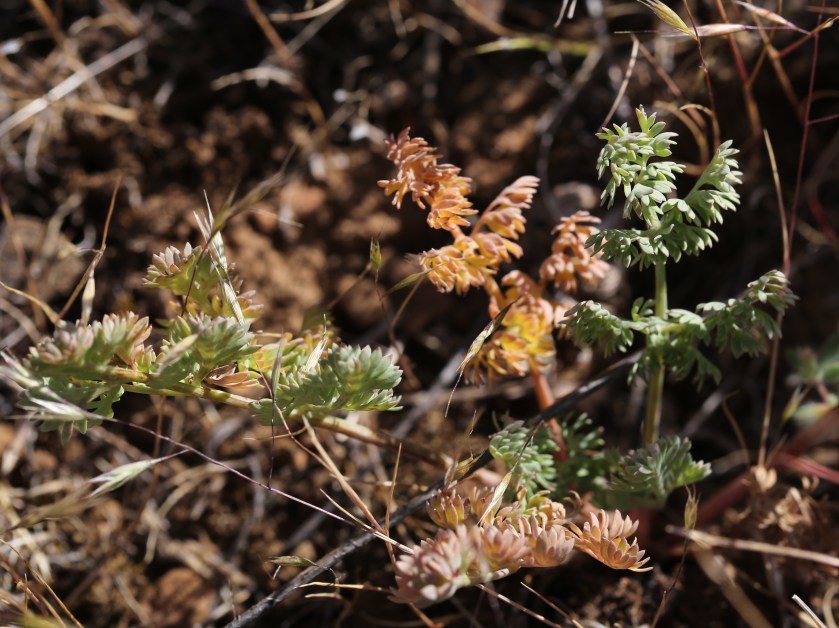
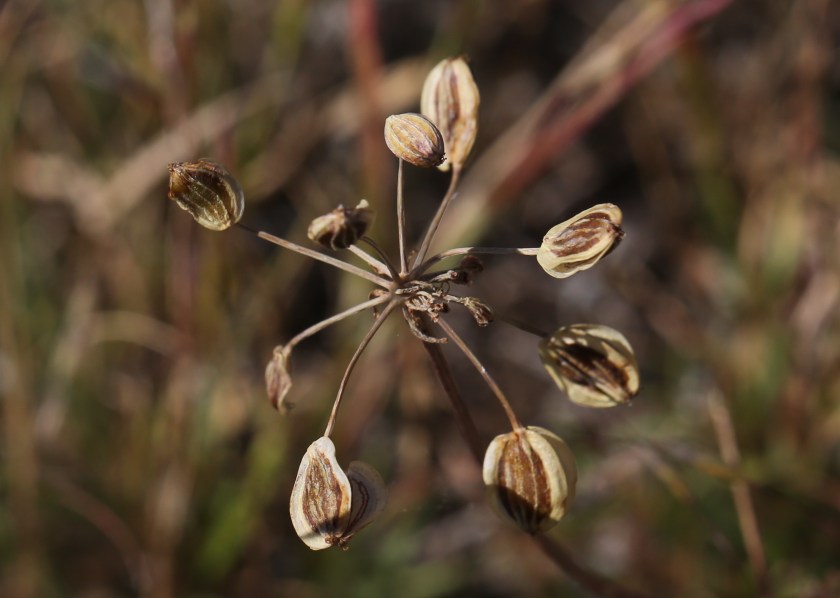
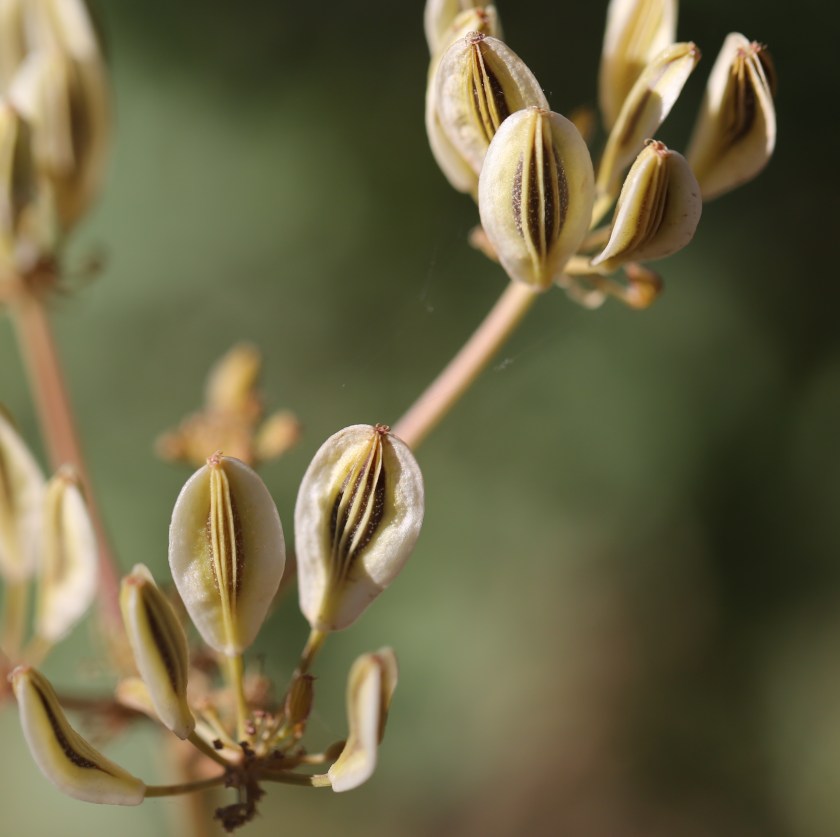
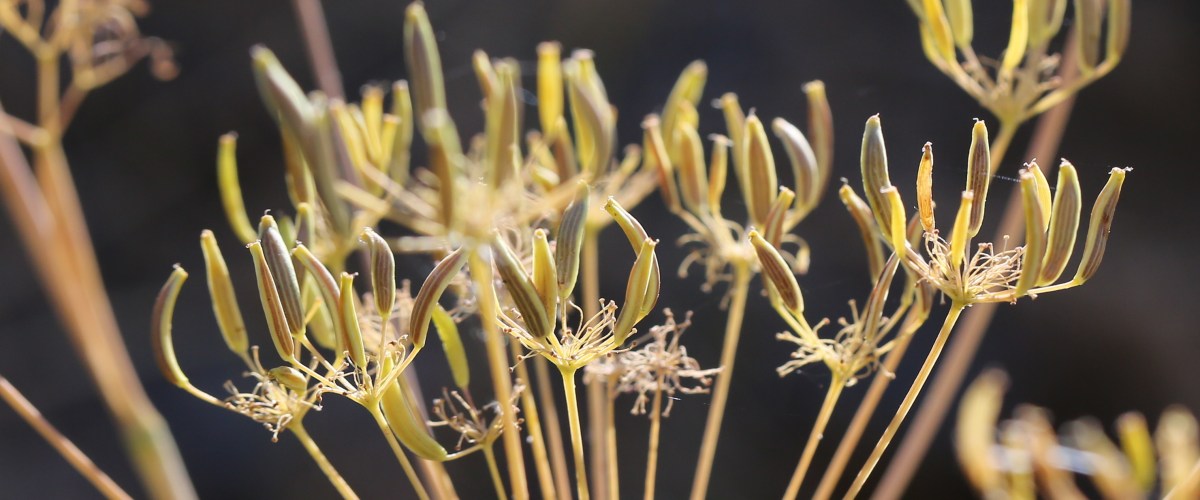
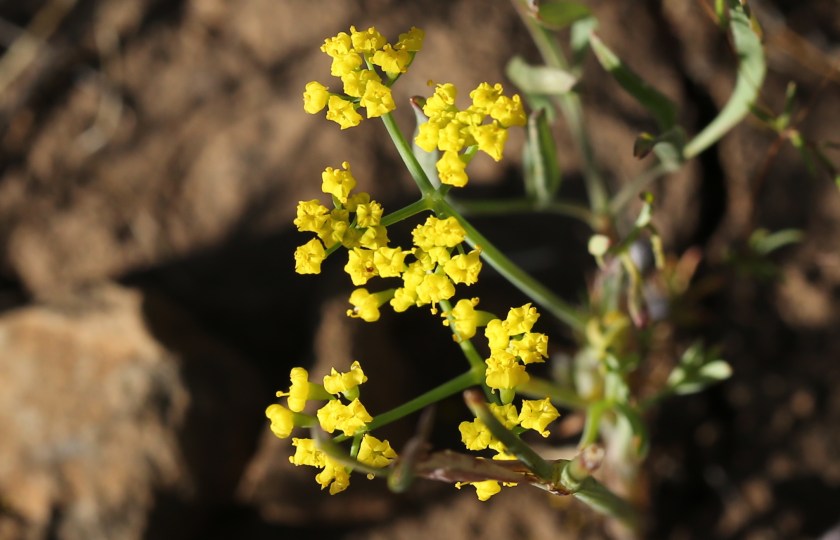
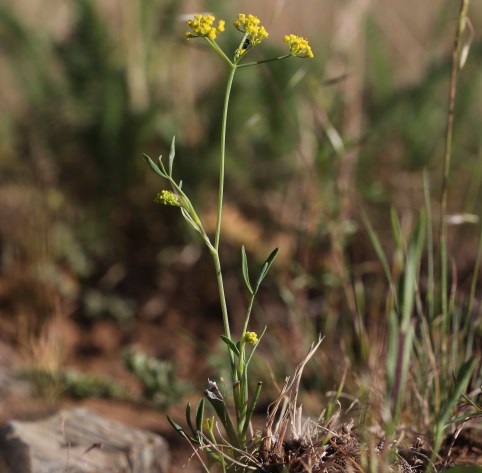
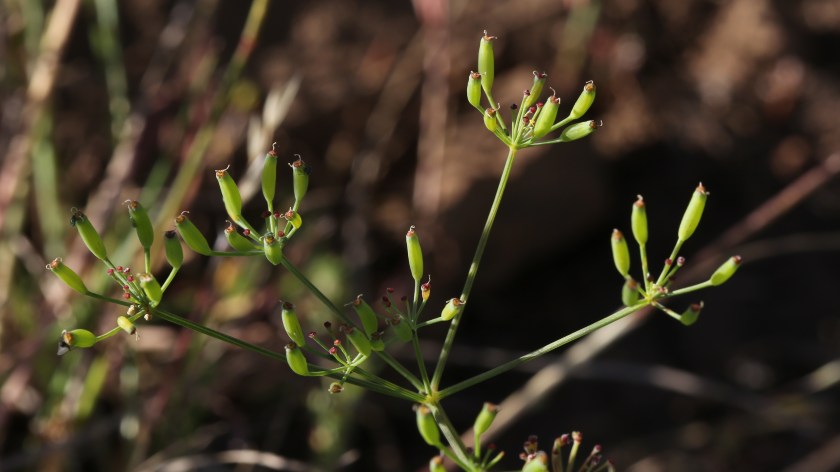
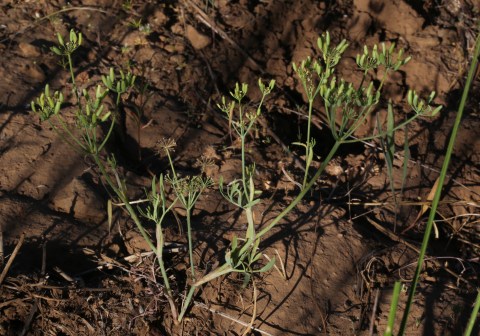
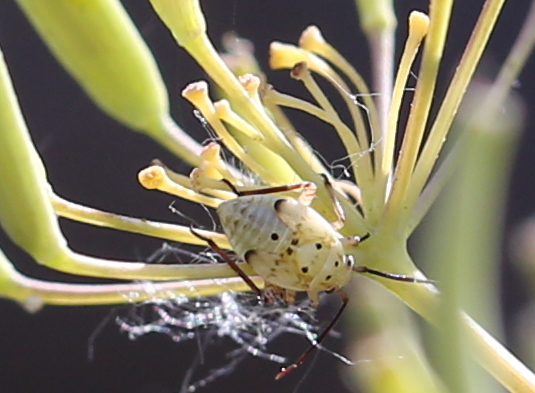
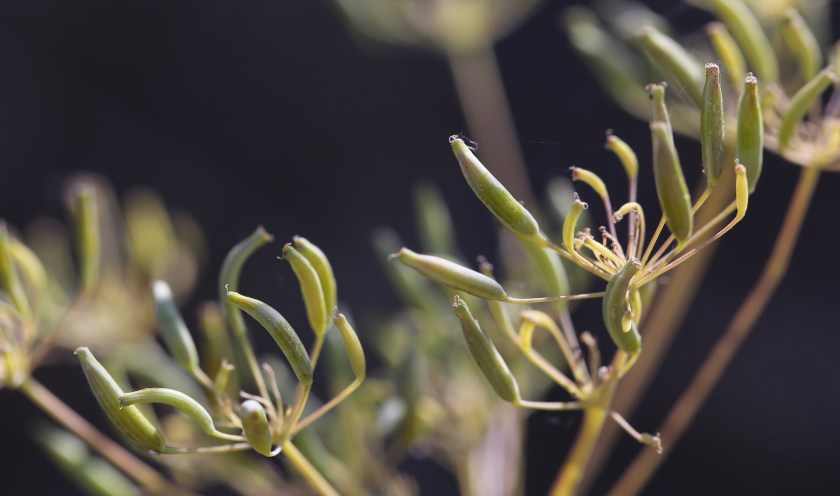
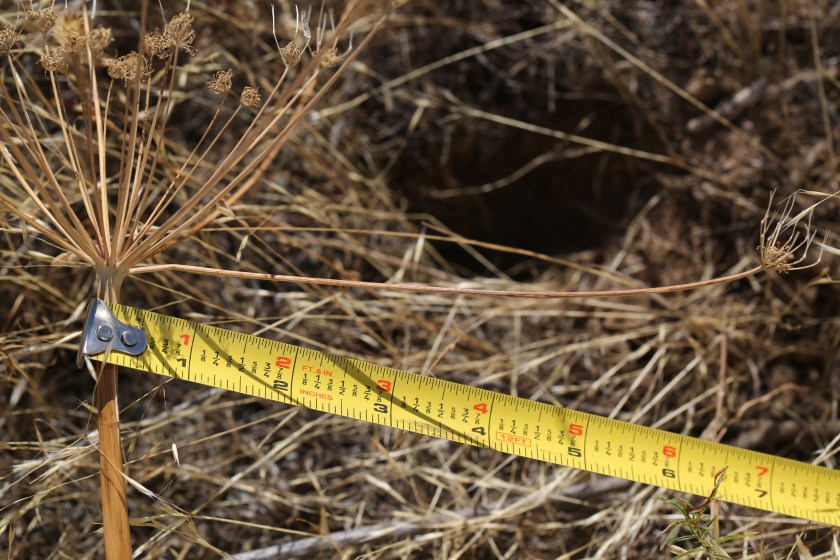
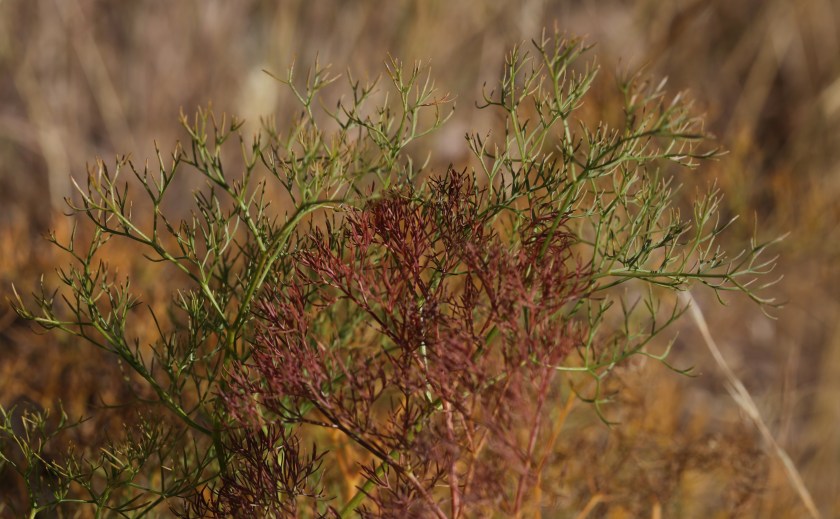
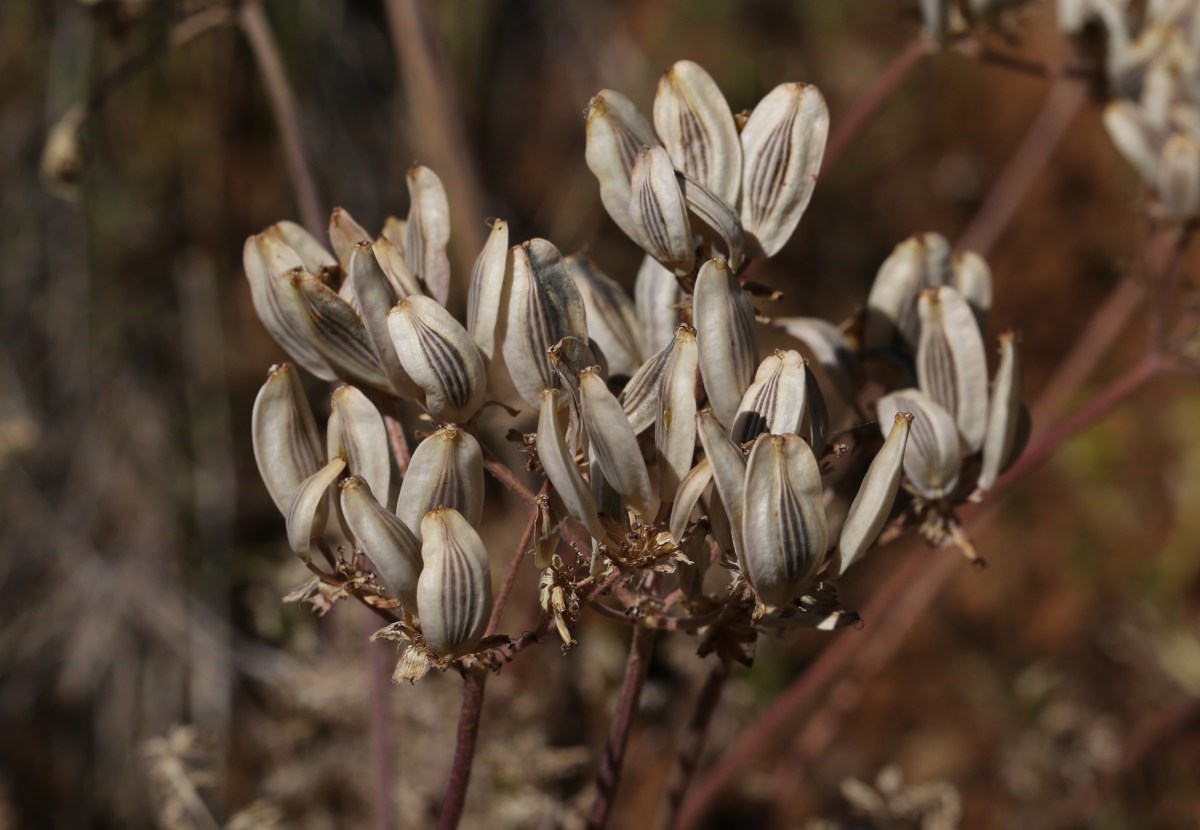
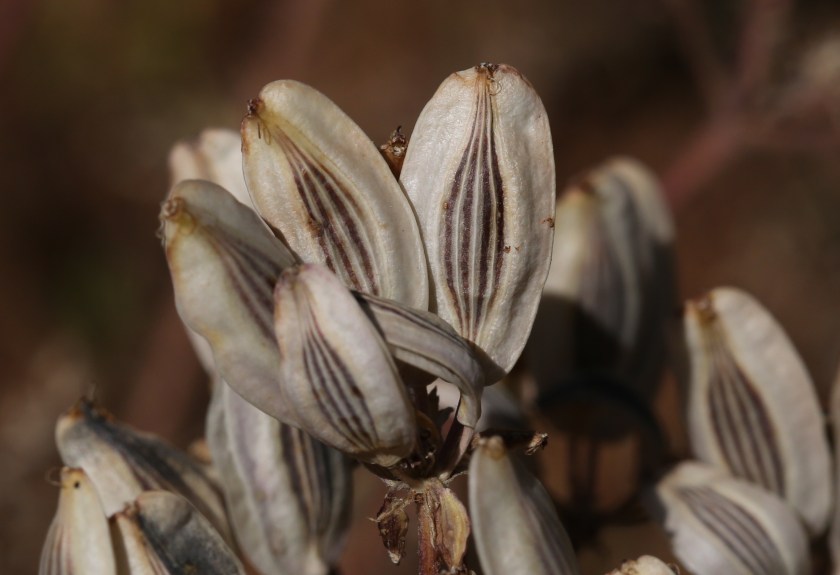
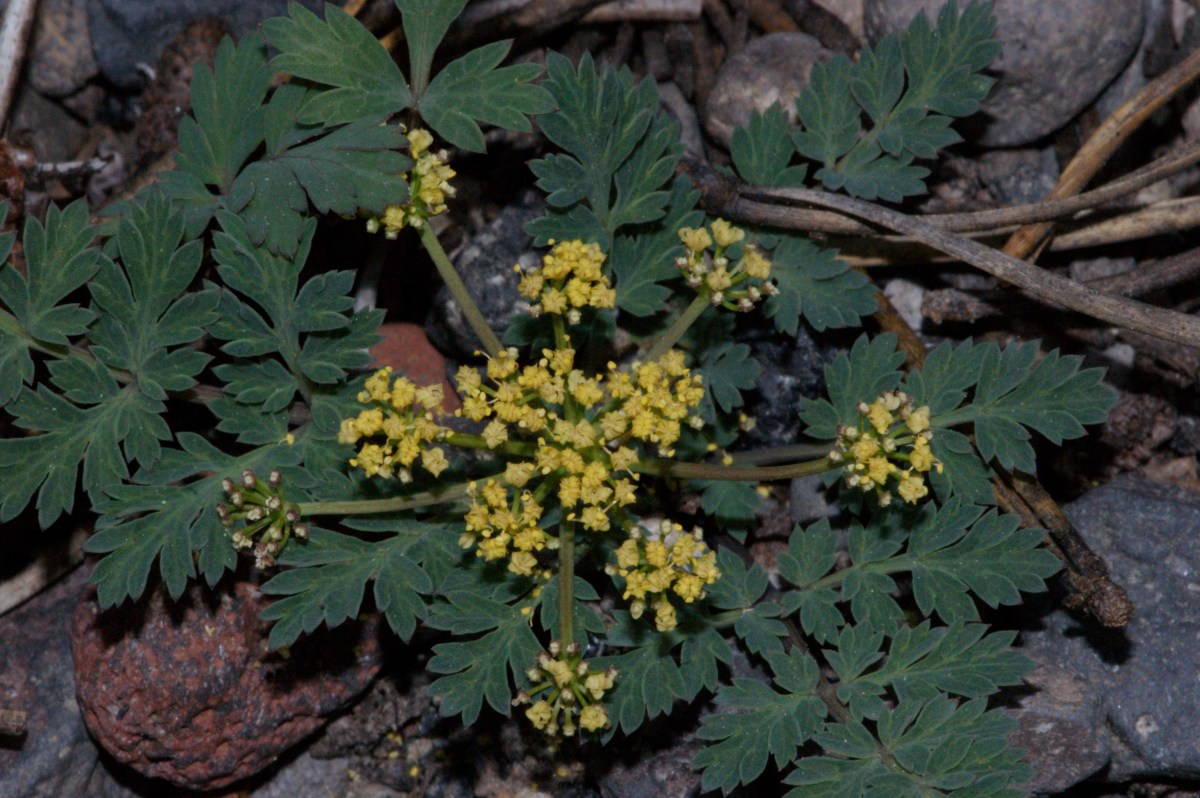
Description. The plants of that species of tuberous lomatium are acaulescent and 7 to 25 cm high at maturity. Glabrous leafless scapes, ascending or suberect, arise from roots, of black color, which are globose with a base up to 4 cm in diameter surmounted by an elongate upper portion. The basal leaves are ternately and pinnately divided and dissected into very numerous ultimate leaf segments being 1 to 5 mm long and 0,5 to 1,3 mm wide with rounded or blunt apices. The leaf blades are 1 to 9 cm long, glabrous to gray-green glaucous and their general outline is oblong to ovate. The pinkish-purplish tinged petioles are wholly sheathing, scarious and with purple veins. The inflorescence is a glabrous compound umbel consisting of 5-16 rays which are from 1 cm to 6 cm long. The involucels are present. The free and linear bracts (3 to 7) are 1,5 to 4 mm long and 0,1 to 0,5 mm wide with acute to acuminate apices. Each umbellet consists of 10 to 20 flowers which have white petals with a smooth stylopodia and anthers of dark purple color (giving a purple cast) or, sometimes, of yellow color. The ovaries are glabrous. The broadly elliptic to ovate fruits – ligulate in cross-section – are 6-13 mm long and 4-7,5 mm wide and possess 1 to 3 oil canals in the intervals and 2 to 6 oil canals in the commissures. Their pedicels are 5-16 mm long at maturity. Their lateral wings are 1 to 2 mm wide.

Phenology. The flowering period is from mid-February through late April through June and the maturing of the fruits range from April to July.

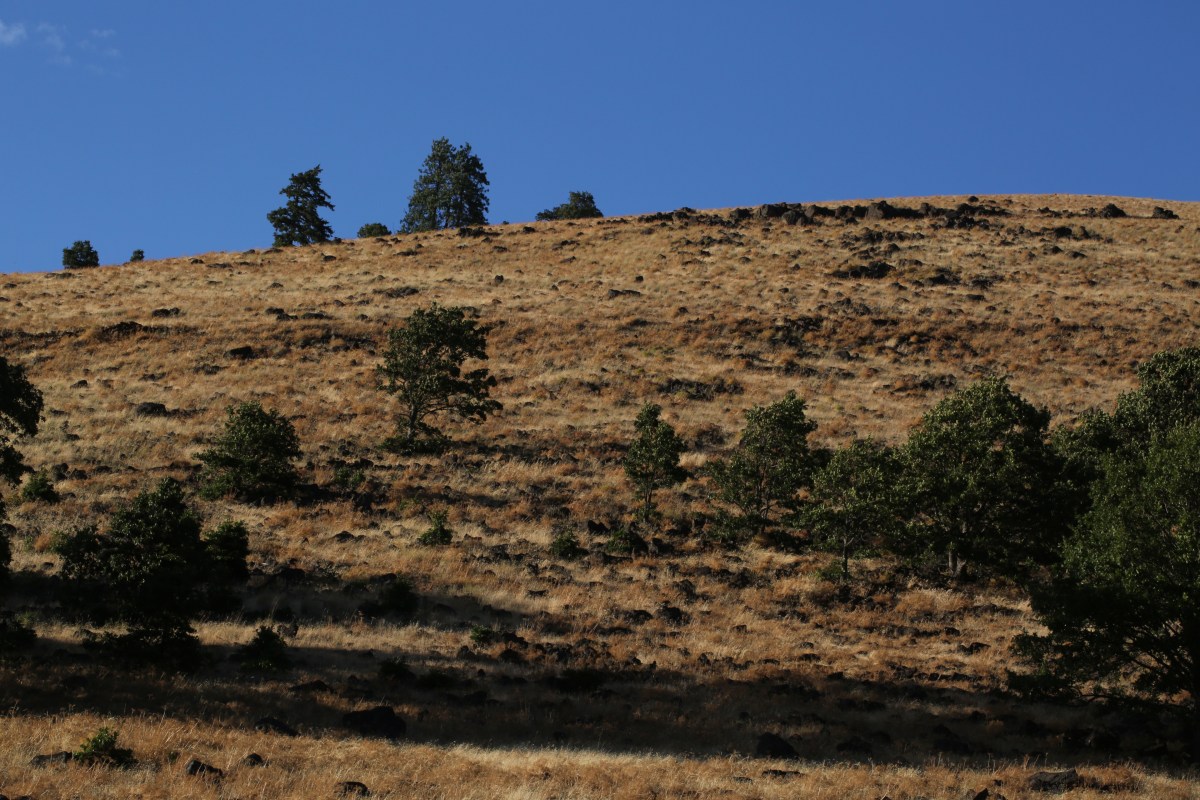
Territories. Eastern-central Washington and eastern Oregon; northern California and Nevada: disjunct to Nez-Percé County in Idaho.
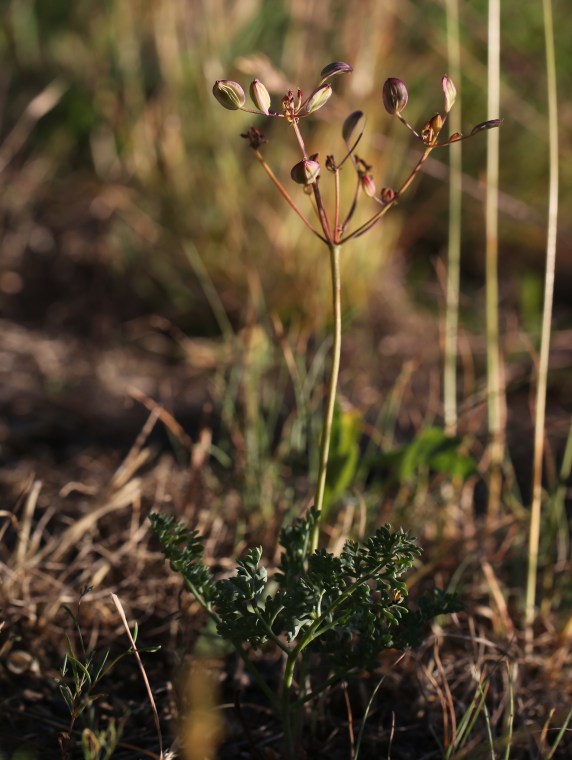
Lomatium canbyi 01

Lomatium canbyi 07

Lomatium canbyi 03

Lomatium canbyi 09

Lomatium canbyi 05

Lomatium canbyi 08

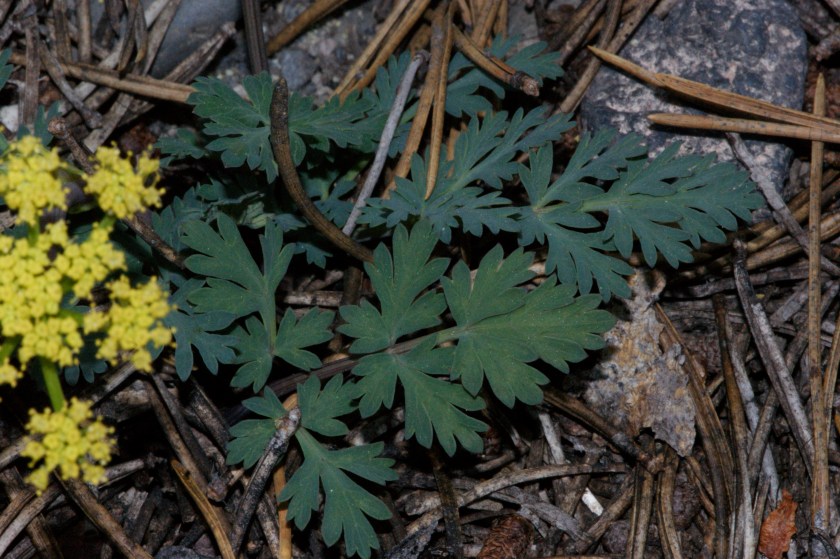
Lomatium peckianum

Description. The plants are glaucous and glabrous or minutely scabrous and are from 10 to 45 cm high. The taproot is slender and scabrous. The leaves have 5/10 cm wide blades with ternately or ternate-pinnately dissected, segments which are linear to oblong and from 1 to 15 mm of length. The inflorescence is a compound umbel and the 8-12 rays are from 1 cm to 7 cm long. The spreading peduncles are from 10 to 40 cm in length. The color of the corolla is cream to lemon-yellow. The 5 to 10 bractlets are 2-7 mm long. The glabrous fruits are oblong-elliptic to elliptic and from 8 to 15 mm of length with pedicels from 3 to 6 mm of length and with wings about half the width of the body. The obscure oil tubes are several per rib-interval.
Lomatium peckianum 02

Lomatium ambiguum

Ethnobotany. A food for the Montana and the Okanagan-Colville Peoples. The spring roots were reduced to flour and the dried flowers and upper leaves were used to flavor meats, stews and salads. The Okanagan-Colville used this Lomatium also as a remedy: an infusion of flowers and upper leaves was taken for colds and sore throats. According to Turner, Nancy J., R. Bouchard and Dorothy I.D. Kennedy in “Ethnobotany of the Okanagan-Colville Indians of British Columbia and Washington, Victoria” (1980); and according to Blankinship, J. W. in “Native Economic Plants of Montana, Bozeman” (1905).

Description.

Lomatium ambiguum 13

The pictures were taken close to Turnbull National Wildlife Refuge, west of Spokane, in Washington and in the Umatilla Forest and the Wallowa Mountains in Oregon.

Lomatium ambiguum 15

Lomatium ambiguum 18

Lomatium ambiguum 11

Lomatium ambiguum 15

Lomatium ambiguum 10

Lomatium ambiguum 17

Lomatium ambiguum 12

Lomatium ambiguum 03

Lomatium ambiguum 09

Lomatium ambiguum 07

Lomatium ambiguum 08

Lomatium ambiguum 04

For other beautiful pictures of Lomatium ambiguum in flowers, you may consult Paul Slichter ‘s website.

Lomatium suksdorfii

Description. A perennial species

Recent researches. In “An analysis of the volatile oil of Lomatium suksdorfii” (1960), Frank Pettinato, Louis Fischer and Nathan Hall have shown that the volatile oil of the fruits of Lomatium suksdorfii, obtained by steam distillation, was found to consist of over 90 per cent terpene hydrocarbons among which α– and β-pinene, d-limonene, and dβ-phellandrene were identified. Isovaleric acid was identified as a component of the oil, and both acetic acid and isovaleric acid were found in the aqueous portion of the steam distillate. Beta-phellandrene is reported to exhibit antifungal and antibacterial activities as it has been demonstrated in the study of another Apiaceae “Chemical Composition and Antimicrobial Activity of Essential Oils Isolated from Aerial Parts of Prangos asperula Growing Wild in Lebanon”. 

In 1994, Lee et al have demonstrated that the pyranocoumarin Suksdorfin, which is isolated from the fruits of Lomatium suksdorfii, was found to inhibit HIV-l replication in the T cell line H9. This coumarin is related to the anti-HIV coumarins found in the genus Peucedanum, the genus to which the Lomatium had originally been ascribed. 


Lomatium suksdorfii 05

Lomatium suksdorfii 06

Lomatium suksdorfii 02

Lomatium suksdorfii 08

Lomatium suksdorfii 09

Lomatium suksdorfii 04

Lomatium suksdorfii 20

Lomatium suksdorfii 21

Lomatium cous

Ethnobotany. A food for the Montana, Oregon, Nez-Percé and the Okanagan-Colville Peoples. The spring roots were reduced to flour for future use or eaten fresh. With the Oregon People, the roots were eaten at the first feast of the new year which was called the Root Feast. According to Turner, Nancy J., R. Bouchard and Dorothy I.D. Kennedy in “Ethnobotany of the Okanagan-Colville Indians of British Columbia and Washington, Victoria” (1980); according to Murphey, Edith Van Allen in “Indian Uses of Native Plants” (1959); according to Jeff Hart in “Montana Native Plants and Early Peoples” and according to Blankinship, J. W. in “Native Economic Plants of Montana, Bozeman” (1905). It was named “racine blanche” by the French speaking Canadians. It was the second most important root for the Nez-Percé – the first being camas. They traded their Lomatium cous with the Flathead who did not enjoy this larger and more abundant biscuitroot – Lomatium cous being the most abundant edible lomatium in the northern Rocky Mountains region and one of the three main root staples, for the Native Peoples, with Camassia  quamash and Lewisia rediviva

The Native People dug the plants in the springtime, just after blooming. They peeled them to eat them fresh or boiled. Some of the roots were sun-dried and the rest was pulverized in a mush to make long cakes which were suspended on a frame of sticks to be partly baked above a fire. They were pierced with a hole to be attached to the horse-saddles. When properly dried and prepared, the biscuitroot cakes could keep for up to 2 years.

David French and Eugene Hunn in their monography “Lomatium: a key resource for the Columbia Plateau Native Subsistence” (1981) explained that Lomatium cous was one the main 10 species of eaten Lomatium providing 30 % of the root food resources of the Native Peoples of Sahaptin languages in the north-west of the USA. In 1981, only 29 species of Lomatium were botanically described, for the Sahaptin spoken range, but most of them were known (if not named) by these Native Peoples – well the survivors as some of the Native Peoples of Sahaptin languages are extinct. Lomatium cous was named “x̣áwš” in Sahaptin language and “qáamsit” (when fresh) and “qáaws” (when peeled and dried) in Nez-Percé language. The roots of Lomatium cous weigh in average 10 grams and one kilogram of fresh roots provide 1270 kcal. David French and Eugene Hunn calculated that a woman would need 400 hours of work to gather all the roots of Lomatium cous necessary for one year to sustain her family. 

Description. The plants of that species of tuberous lomatium are acaulescent or caulescent and 10 to 35 cm high at maturity. The roots, of black color, are elongate and slender or, sometimes, tuberous – and up to 8 cm in length and 4 cm in width. The leaf blades are 2 to 14 cm long, glabrous, glaucous and often scaberulous and their general outline is oblong to obovate. The leaves are ternately or pinnately divided and dissected – the ultimate leaf segments being linear, 1 to 12 mm long and 0,5 to 3 mm wide with mucronulate or apiculate apices. The green to purple tinged petioles are sheathing for half of the length of the basal leaves and only at the base of the cauline leaves. The inflorescence is a glabrous to scaberulous umbel consisting of 5 to 20 rays which are 1 to 11 cm long. The bracts (4 to 12) are free or fused on a little segment of their length, narrowly to broadly obovate, 2 to 5 mm long and 1 to 3 mm wide. Each umbellet consists of 10 to 20 flowers which are all yellow: petals, anthers and stylopodia (punctuated by small vacities). The ovaries are glabrous to granular. The oblong to broadly elliptic fruits, with a lingulate cross-section, are 5-12 mm long and 2-6 mm wide and possess 1 to 4 oil canals in the intervals and 4 to 7 oil canals in the commissures. Their pedicels are 1-5 mm long at maturity. Their lateral wings are 0,4 to 1,7 mm wide.

Lomatium cous 02

Lomatium cous 03

Lomatium cous 04

Lomatium martindalei

Description. Perennial species with one to several flower scapes rising 10-30 cm high from a cluster of basal leaves and from an elongate taproot and usually simple, subterranean crown. The foliage is glaucous. The leaves are pinnately or ternate-pinnately once to twice compound – the ultimate segments being leaf-like, toothed or cleft. The flowers are white, yellow or ochroleucous. The inflorescence is an umbel composed of 4 to 16 rays of 2-7 cm of length. The pedicels are 2-15 mm long. The fruits are dark purplish in color, oblong to broadly elliptic, 6-16 mm long with the wings equaling or narrower than the body and with prominent dorsal and intermediate ribs.

SONY DSC

SONY DSC

SONY DSC

Lomatium tamanitchii

Description. According to Mark Darrach et al inLomatium tamanitchii (Apiaceae) a New Species from Oregon and Washington State, USA”: «Lomatium tamanitchii (Apiaceae), is a newly discovered substrate-specific, narrow endemic species. The species grows on clay soils in grassland swales and gentle slopes in the Columbia Hills of eastern Klickitat County in south-central Washington State. A small disjunct occurrence has also been recently recognized in Union County, Oregon. The species is most typically distinguished by a multi-branched caudex surmounting a large, thick, blunt-tipped taproot. It is identified by its sparsely to densely short hairy leaves with broadly winged petioles, and its narrowly elliptical dorso-ventrally compressed fruits that have short hairs and distinct narrow raised ventral ribs. Lomatium tamanitchii is clearly distinct from all other species in the genus as based primarily upon gaps in characters of fruit morphology and vestiture. Populations occur in dense near-monocultures strictly confined to shrink-swell soils derived from devitrified silicic volcanic ash on massive landslide deposits. The known range of Lomatium tamanitchii is restricted to a small area in eastern Klickitat Co., Washington and several hundred plants in a newly-discovered disjunt population approximately 180 km distant in Union County, Oregon. This limited distribution raises conservation concerns. Lomatium tamanitchii is compared with morphologically similar taxa growing in nearby areas of the Columbia Basin. »

Lomatium tamanitchii 06

Lomatium tamanitchii 02
Narrowly elliptical dorso-ventrally compressed fruits which have short hairs and distinct narrow raised ventral ribs.

Lomatium tamanitchii 03

Lomatium tamanitchii 01

Lomatium tamanitchii 05
All the pictures of seeds of Lomatium tamanitchii were taken – on July 9 th 2017 – up old Highway 8 from Highway 14, West of Roosevelt, Klickitat County, Washington. 45°44’10” N 120°16’29” W.

Other beautiful pictures of that rare species in flower may be consulted on Paul Slichter’s website.

Erythranthe lewisii var. albiflorum

In July 2009, I discovered different white populations of Mimulus lewisii at Crater Lake in Oregon. There was no mention on the web, at that time, of a studied and investigated white form of Mimulus lewisii. Since then, I found a mention of “Mimulus lewisii var. alba” in a publication of 1919 “Torreya: A Monthly Journal of Botanical Notes and News, Volumes 19-20″.

Upon my botanical discovery, I informed, twice, the direction of the Park but I never got any answer. In August 2009, Douglas W. Schemske, of the Michigan State University (Department of Plant Biology), told me he would be interested by a few seeds stemming from the few dry pods of the white flowered plant I had dry-pressed. Douglas W. Schemske had already published two studies on the genetic evolution of that species. I sent the seeds to his university and told him that one of the populations of lilac flowers and lilac-white flowers of Mimulus lewisii had just been destroyed a few days before due to reconstruction of the road along the cliff – about 3 kms north of the Falls, close to the crossing of Wheeler Creek. Some years later, I realized that this university had already collected, in 2006, rhizomes of white flowered Mimulus lewisii plants – growing along Scott Creek, east of Crater Lake – to study the color polymorphism in that species. The Michigan State University released a publication  in December 2013 titled “The genetic basis of a rare flower color polymorphism in Mimulus lewisii provides insight into the repeatability of Evolution”. 

Paul Slichter, on his botanical website, presents beautiful pictures of an hybrid between Erithranthe lewisii and Erithranthe cardinalis.

Ethnobotany. Many other species in the genus Mimulus (where it belonged before) were used as food or as medicine by the First People. 

Carlos Ramirez (Annals of the Missouri Botanical Garden. 1989) has studied the flora of Rucamanque in Chile, a site dated 13 000 years old. 68 plant species were recovered from the site, of which species of Mimulus. Of these 68 species, today 32 still have medicinal uses.

White flowered Mimulus lewisii at Crater Lake. Oregon.

SONY DSC

Erythranthe lewisii var. albiflorum 07

SONY DSC

A few buds from a mutated population of lilac flowers and lilac-white flowers.

Calochortus nudus

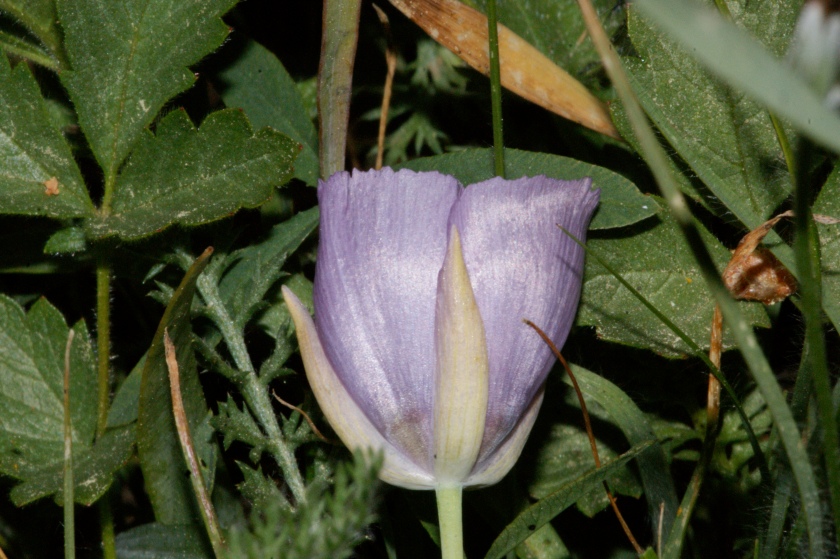
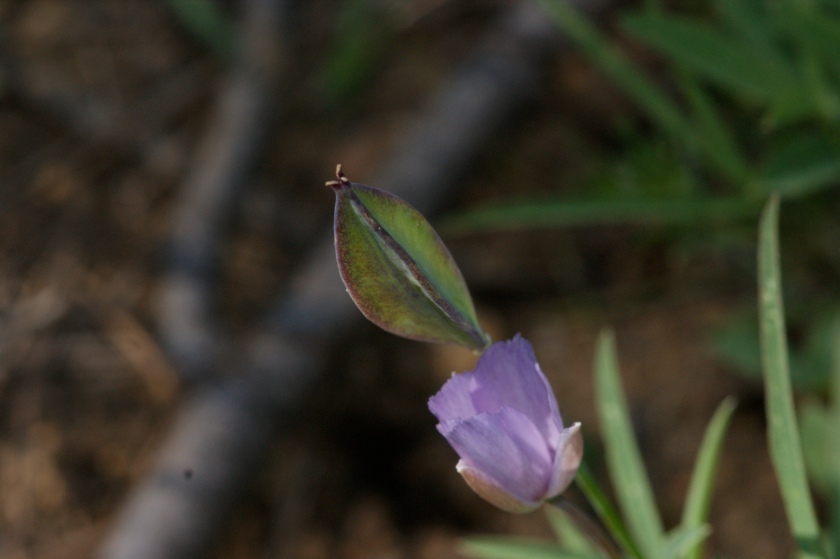
Ethnobotany. A food for many Amerindian Peoples: the bulbs were eaten raw or roasted.

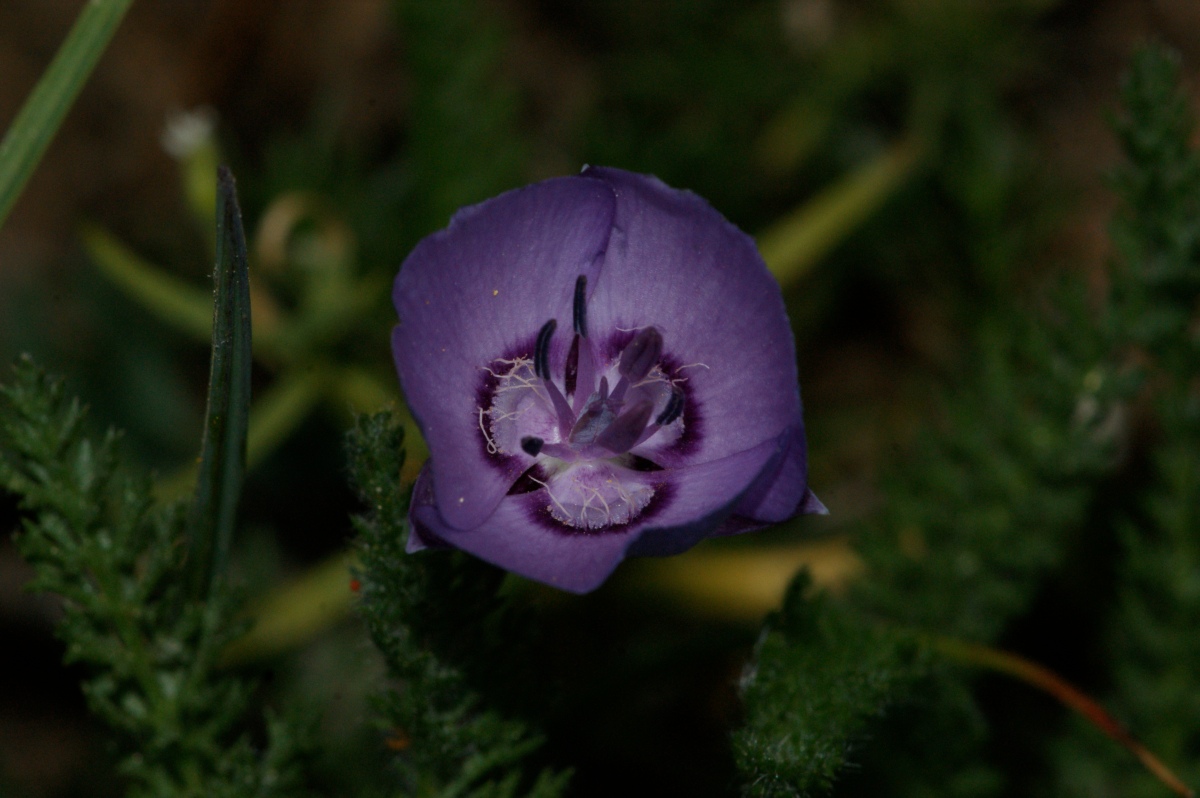
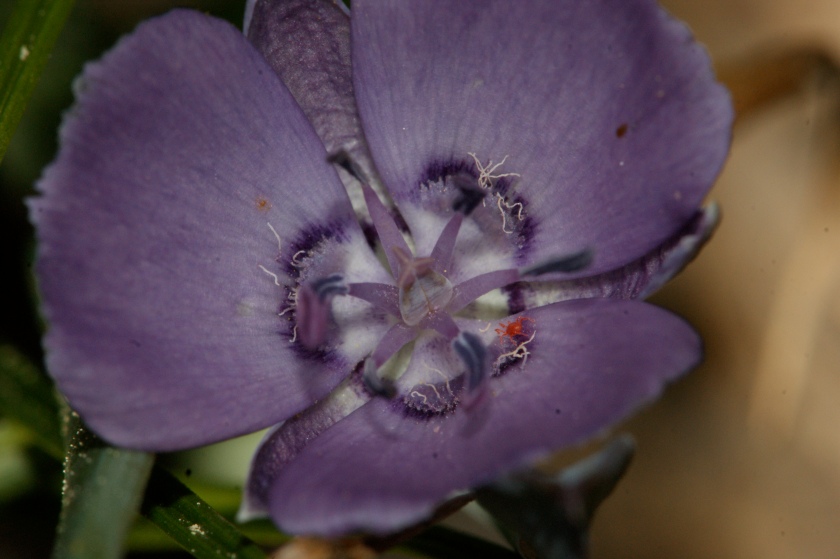
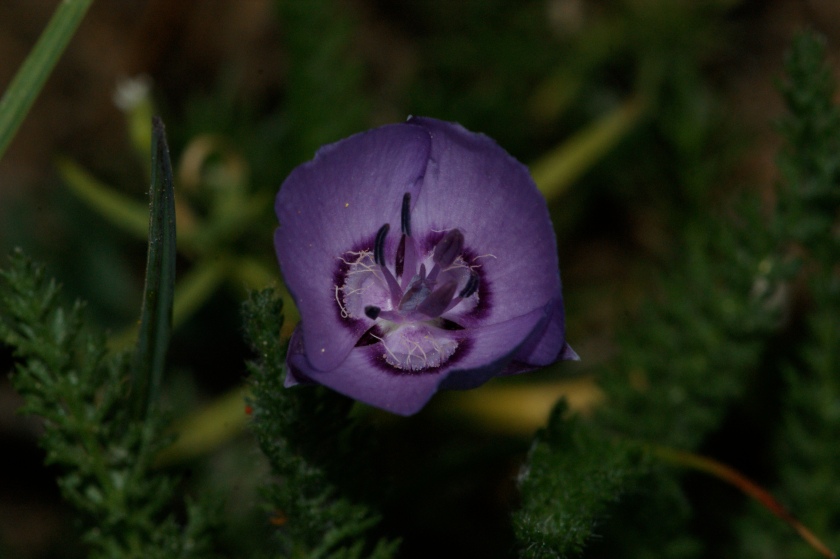
Description by the California Native Plant Society. Calochortus nudus is a species of flowering plant in the lily family known by the common name naked mariposa lily. It is native to the mountains of northern California and southern Oregon, where it grows in wet areas such as meadows and lakeside bogs. It is a perennial herb producing an unbranching stem up to about 25 centimeters tall. The basal leaf is 5 to 15 centimeters long and does not wither at flowering. The flower cluster bears one or more erect, bell-shaped flowers. Each flower has three small, pointed sepals and three wider petals all pinkish or lavender in color. The petals are mostly hairless and about 1.5 centimeters long. The fruit is a capsule about 2 centimeters long.

SONY DSC

SONY DSC

SONY DSC

SONY DSC

Calochortus subalpinus

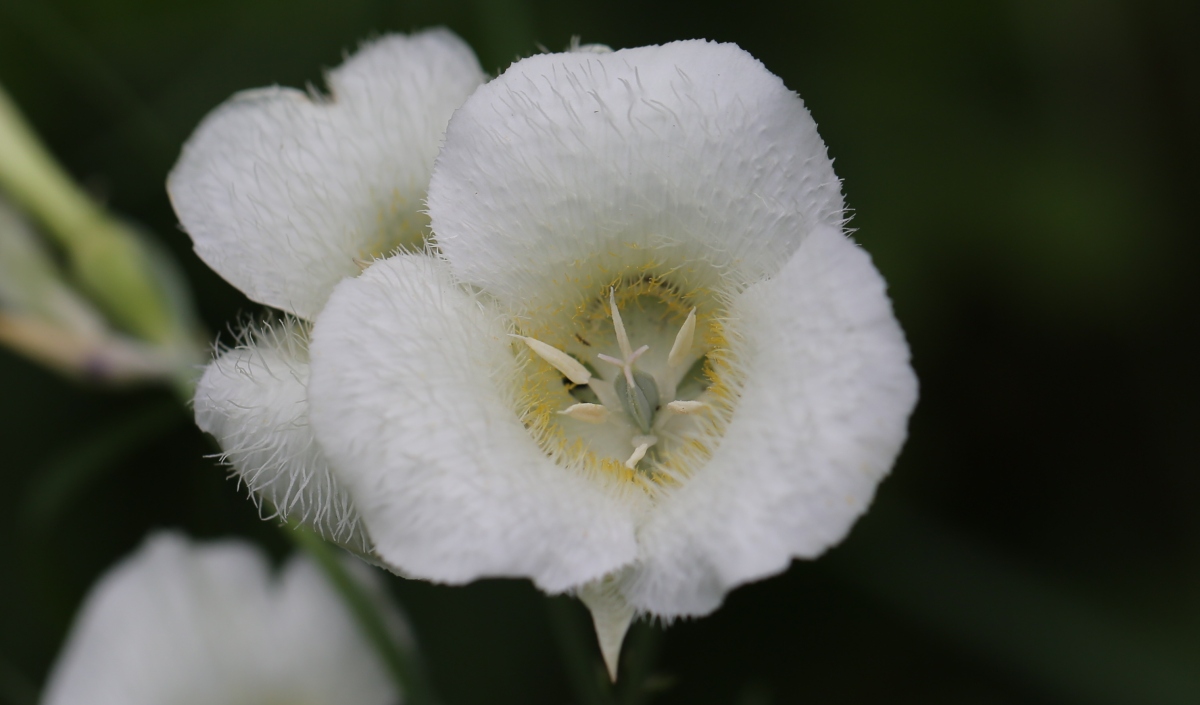
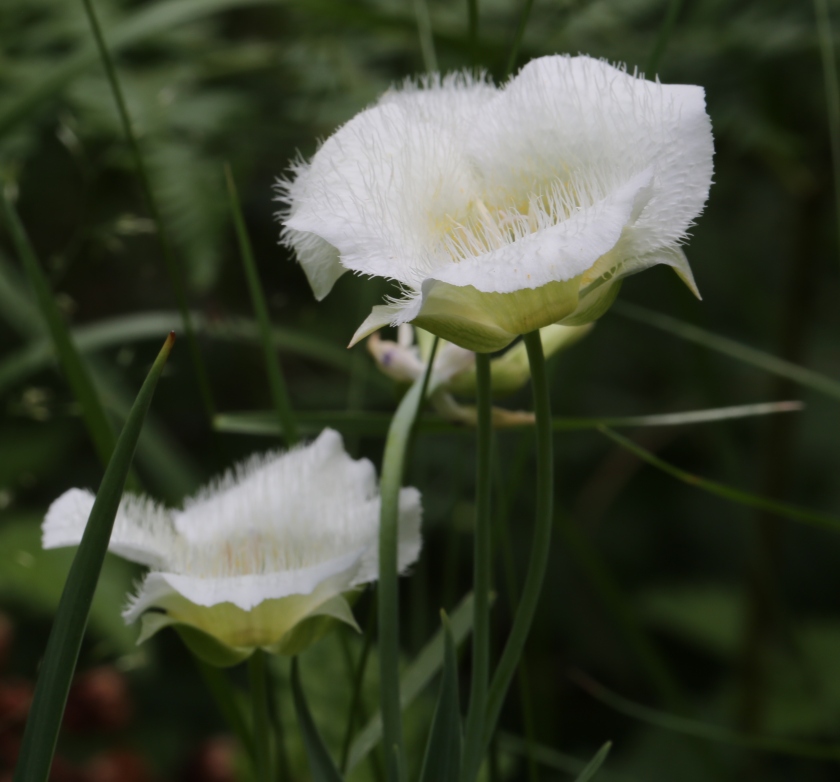
Ethnobotany. A food for many Amerindian Peoples: the bulbs were eaten raw or roasted.

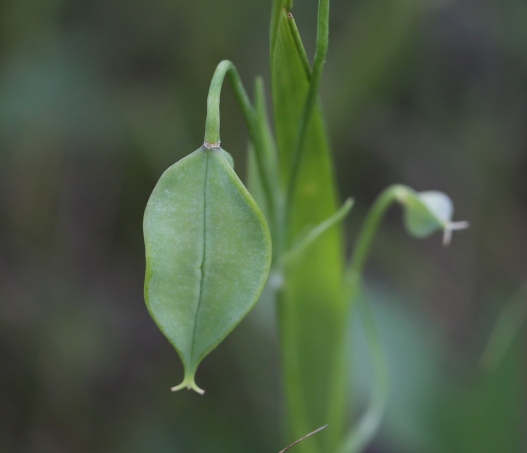
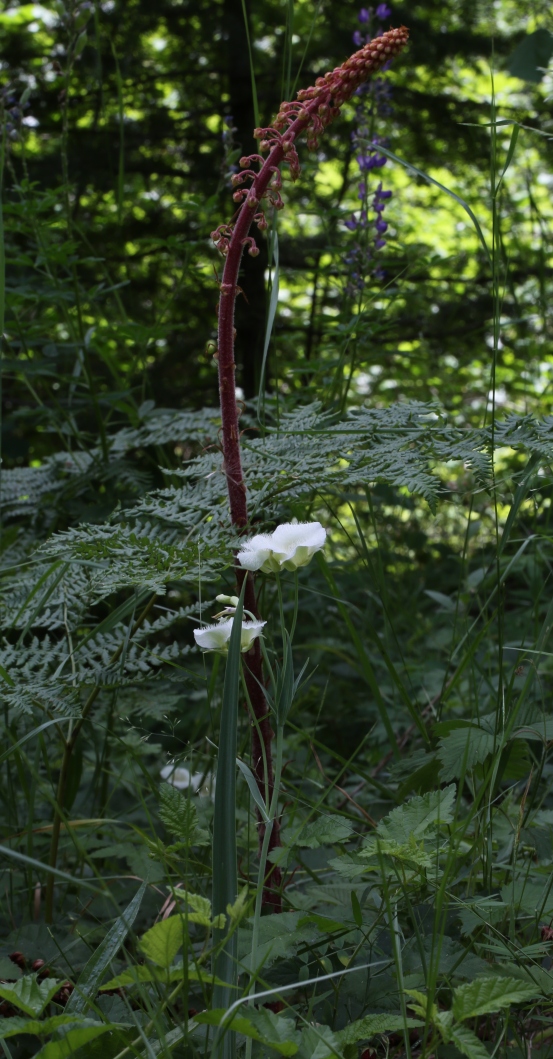
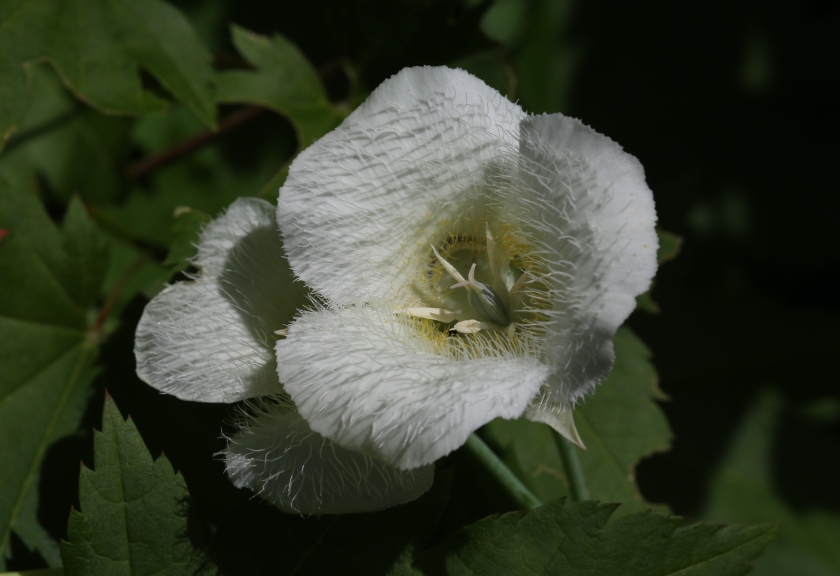
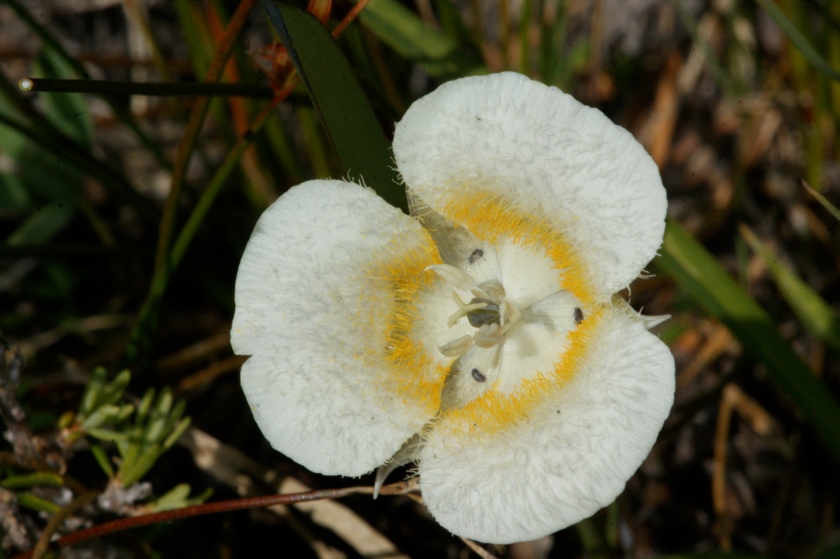
Description from the Flora of North America. Stems usually not branching, straight or flexuous, often scapelike, 0.5–3 dm. Leaves: basal 1–3 dm × 2–15 mm, usually equaling or exceeding stem length; blade flat, adaxial surface glabrous. Inflorescences subumbellate, 1–5-flowered; bracts 2–several, lanceolate to linear, unequal, 1–5 cm, apex acuminate; peduncle slender, becoming stouter, deflexed in fruit. Flowers erect or spreading; perianth open, campanulate; sepals typically with purple glandular blotch near base, oblong-lanceolate, shorter than petals, adaxial surface minutely hairy, apex acute to acuminate; petals yellowish white, sometimes lavender-tinged, frequently with narrow purple crescent distal to gland, broadly obovate, cuneate, moderately bearded nearly to apex, adaxial surface densely hairy, margins fringed, apex obtuse or acute; glands transversely oblong, arched upward, ± deeply depressed, bordered proximally by narrow, ascending, deeply fringed membrane, distally by narrow, crenate membranes, gland surface with rather long, slender hairs toward distal portion; anthers lanceolate, apex long-apiculate. Capsules nodding, 3-winged, ellipsoid, apex usually acute. Seeds pale yellow. 2n = 20. Flowering summer. Open forest in loose volcanic soils; 1000–2200 m; Oregon, Washington.

Calochortus subalpinus 03

Calochortus subalpinus 04

Calochortus subalpinus 05

Calochortus subalpinus 01

The pictures above of Calochortus subalpinus were taken on Mount Adams in Washington in July 2017. The pictures below of Calochortus subalpinus were taken in July 2009 in central Oregon.

SONY DSC

SONY DSC

SONY DSC

SONY DSC