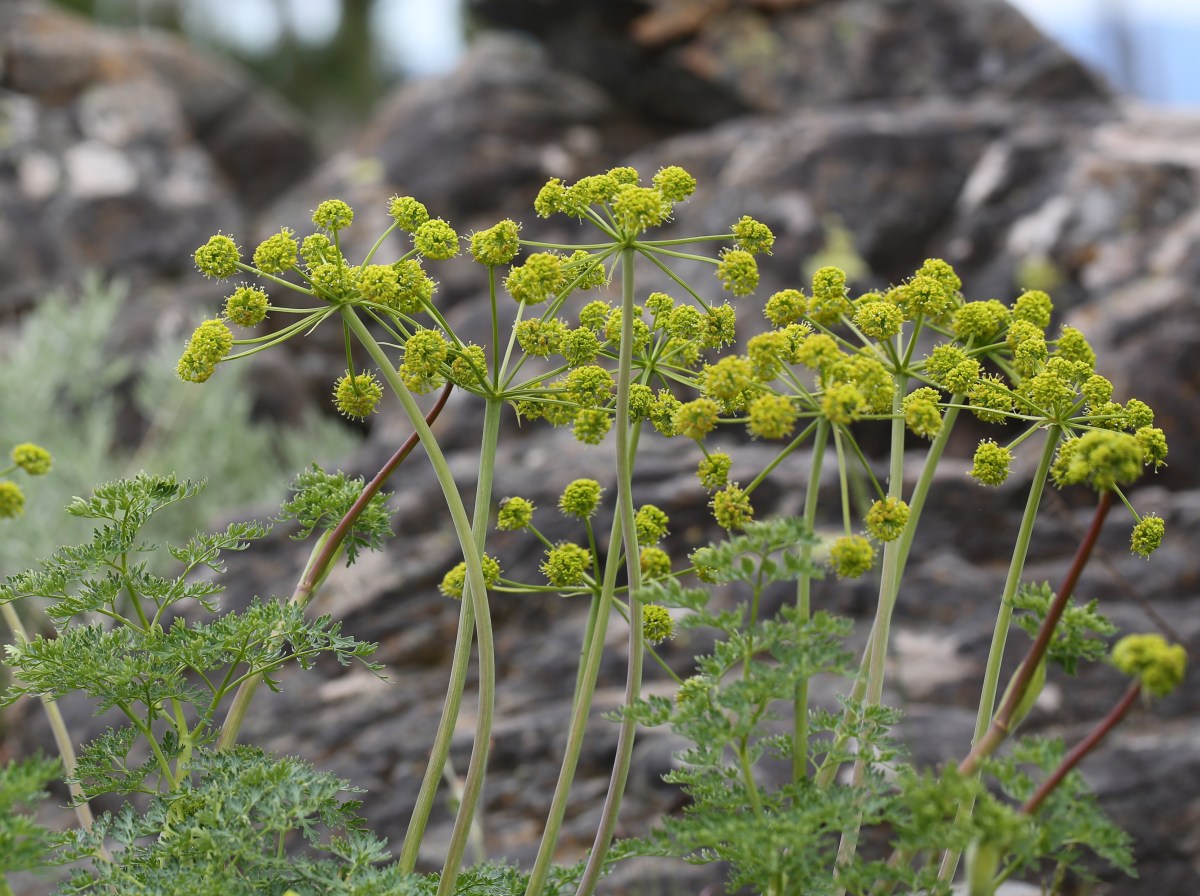
Ethnobotany. Lomatium dissectum has been
Recent researches. Lomatium dissectum contains
Description by the Jepson. Plant 1–5 dm;

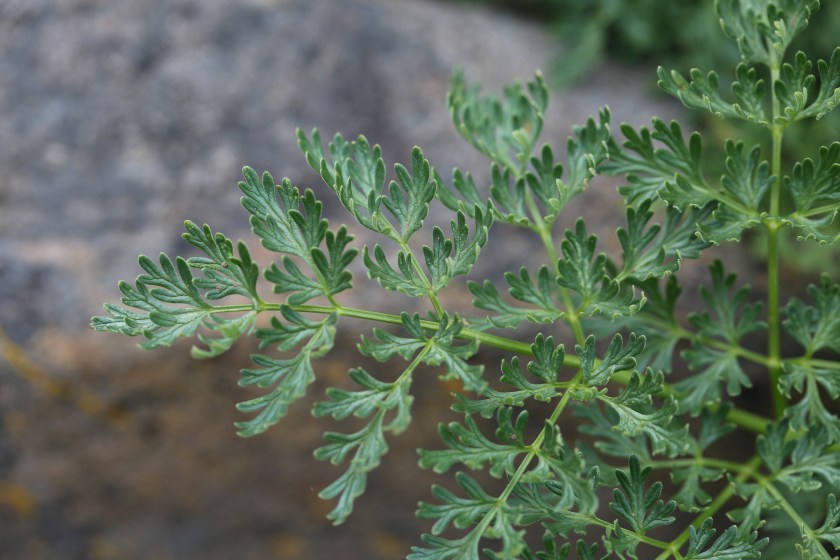
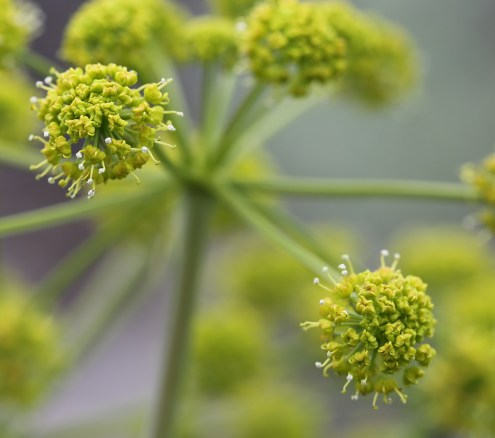
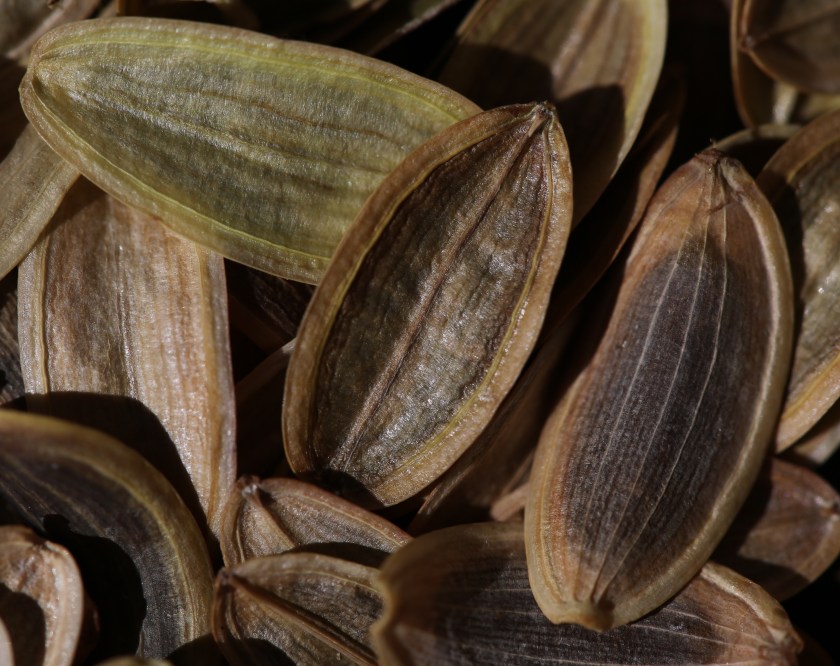
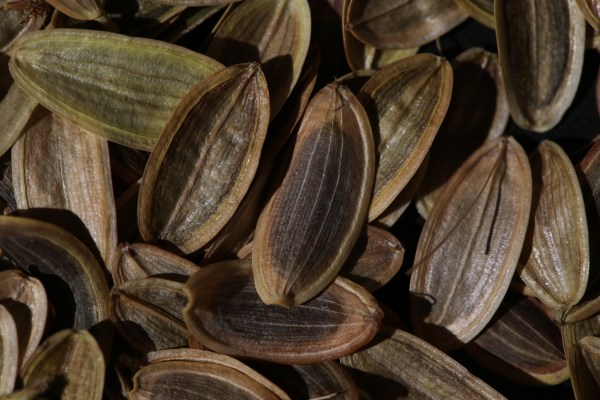


Ethnobotany. Lomatium dissectum has been
Recent researches. Lomatium dissectum contains
Description by the Jepson. Plant 1–5 dm;
Ethnobotany. Lomatium macrocarpum has been used as a food or as medicine by the following First Peoples: Blackfoot, Crow, Flathead, Okanagan-Colville, Paiute, Pomo, Sanpoil, Shuswap and Thompson.
Recent researches. Lomatium macrocarpum contains coumarins and chromones. «Roots of Lomatium macrocarpum (Hook. and Arn.)C. and R. yielded osthol(7-methoxy-8-(3-methyl-2-butenyl)-coumarin) and a chromone, 2-methyl-5-hydroxy-6(3-methyl-2-butenyl)-7-methoxychromone, identified spectroscopically and by synthesis. The serial parts of the plant also contained this chromone along with sibiricin (5,7-dimethoxy-8-(3-methyl-2,3-epoxybutyl)-coumarin) and a new coumarin named macrocarpin. By spectroscopy and chemical degradation macrocarpin was shown to be 7-methoxy-8-(3-methyl-4-(2-methyl-cis-2-butenoyloxy)-cis-2-butenyl)coumarin. These products were not found in four other Lomatium species examined.» in “Coumarins and Chromones from “Lomatium macrocarpum”. Steck,Warren. 1973.
Description by the Jepson. Plant 1–5 dm; taproot or sometimes tubers slender or basally swollen; herbage gray, generally tomentose to densely short-hairy. Stem very short; base not fibrous. Leaf: petiole 1.5–7 cm; blade 2.5–15 cm, oblong to obovate, pinnately or ternate-pinnately dissected, segments 1–7 mm, linear to oblong, entire; cauline leaves like basal. Inflorescence generally tomentose; peduncle 0.5–3 dm; involucel 1-sided; bractlets several, = to > flowers, linear-lanceolate to ovate, acute, ± fused, reflexing, not scarious; rays 5–25, 1–8.5 cm, spreading-ascending; pedicels 1–14 mm. Flower: corolla white, pale yellow, or purplish; ovary generally hairy. Fruit 9–20 mm, lanceolate or oblong to narrowly elliptic, minutely hairy to nearly glabrous; wings generally < body in width; oil tubes per rib-interval 1–3. Chromosomes: 2n=22. Ecology: Rocky (often serpentine) slopes in chaparral or woodland. Elevation: 150–3000 meters. Bioregional distribution: North Coast, Klamath Ranges, Cascade Range, Sierra Nevada Foothills, Tehachapi Mountain Area, San Francisco Bay Area, South Coast . Distribution outside California: to British Columbia, c Canada, ND, Utah.





Ethnobotany. Lomatium utriculatum has been used as a food by the Atsugewi, Kawaiisu and Mendocino First Peoples. Among the Atsugewi, a decoction of plants was used as a wash for swollen limbs. Among the Kawaiisu, a decoction of plant was used as a wash for broken limbs. Among the Salish, the roots were chewed or soaked in water and taken for headaches and for stomach disorders. As mentioned in “Atsugewi Ethnography, Anthropological Records” (Garth, Thomas R., 1953); “Kawaiisu Ethnobotany” (Zigmond, Maurice L., 1981); “Plants Used by the Indians of Mendocino County, California” (Chestnut, V. K., 1902); “The Ethnobotany of the Coast Salish Indians of Vancouver Island” (Turner, Nancy Chapman and Marcus A. M. Bell, 1971).
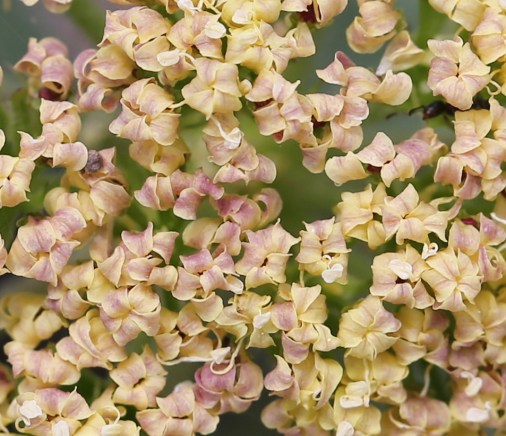
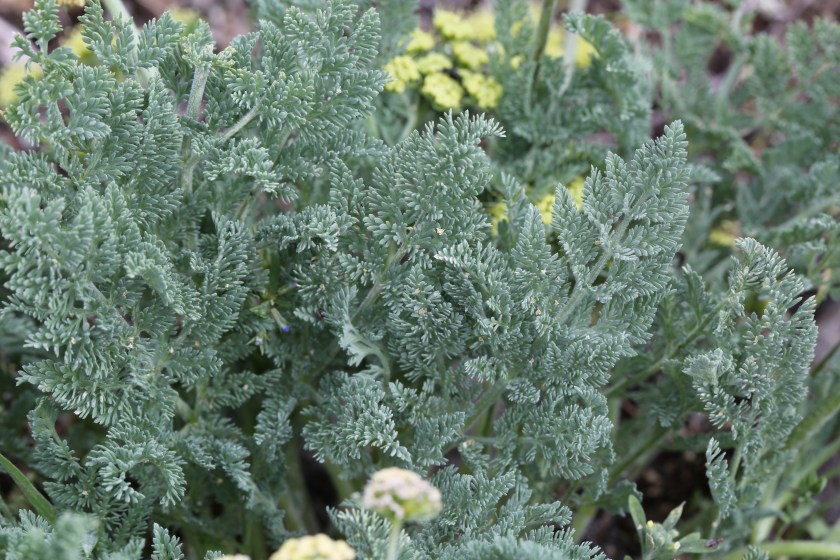
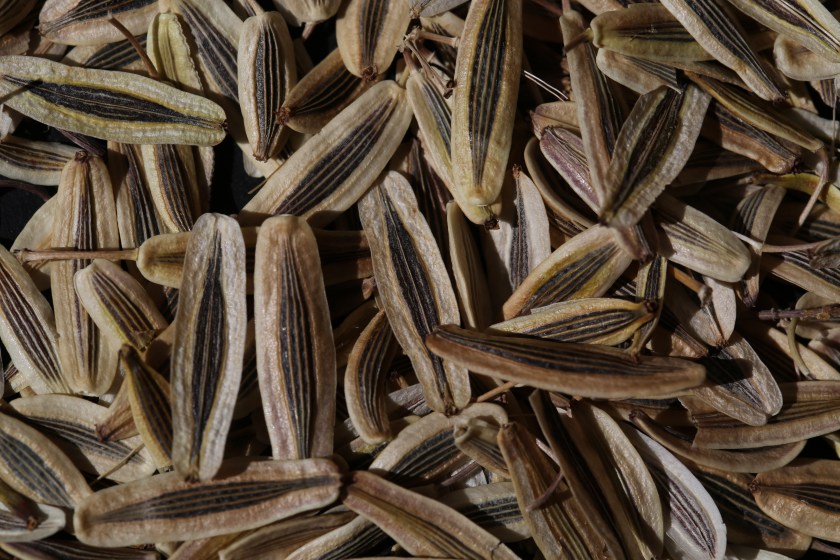
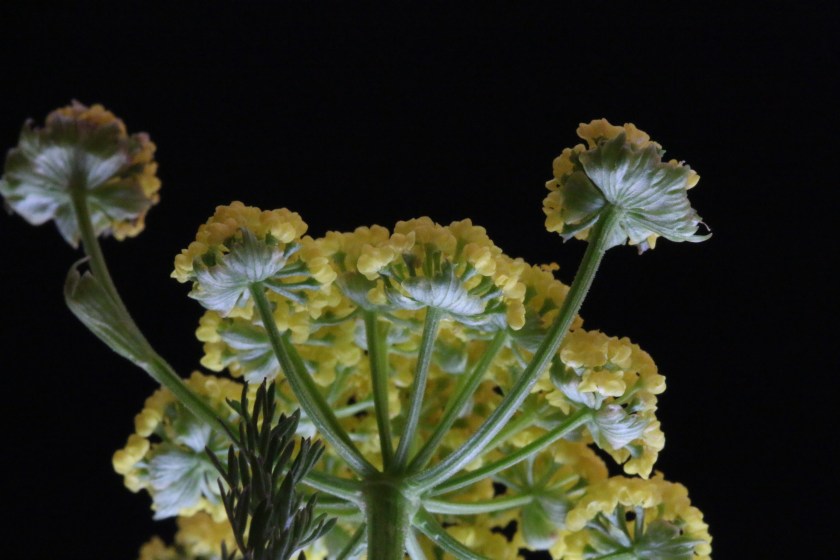
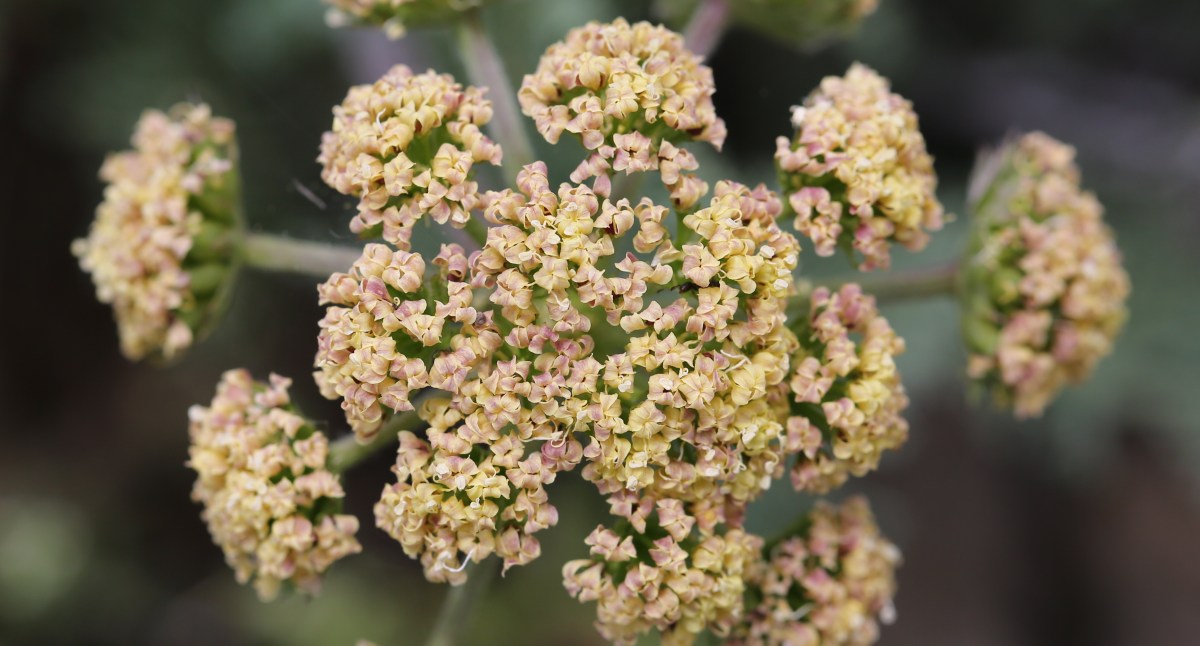
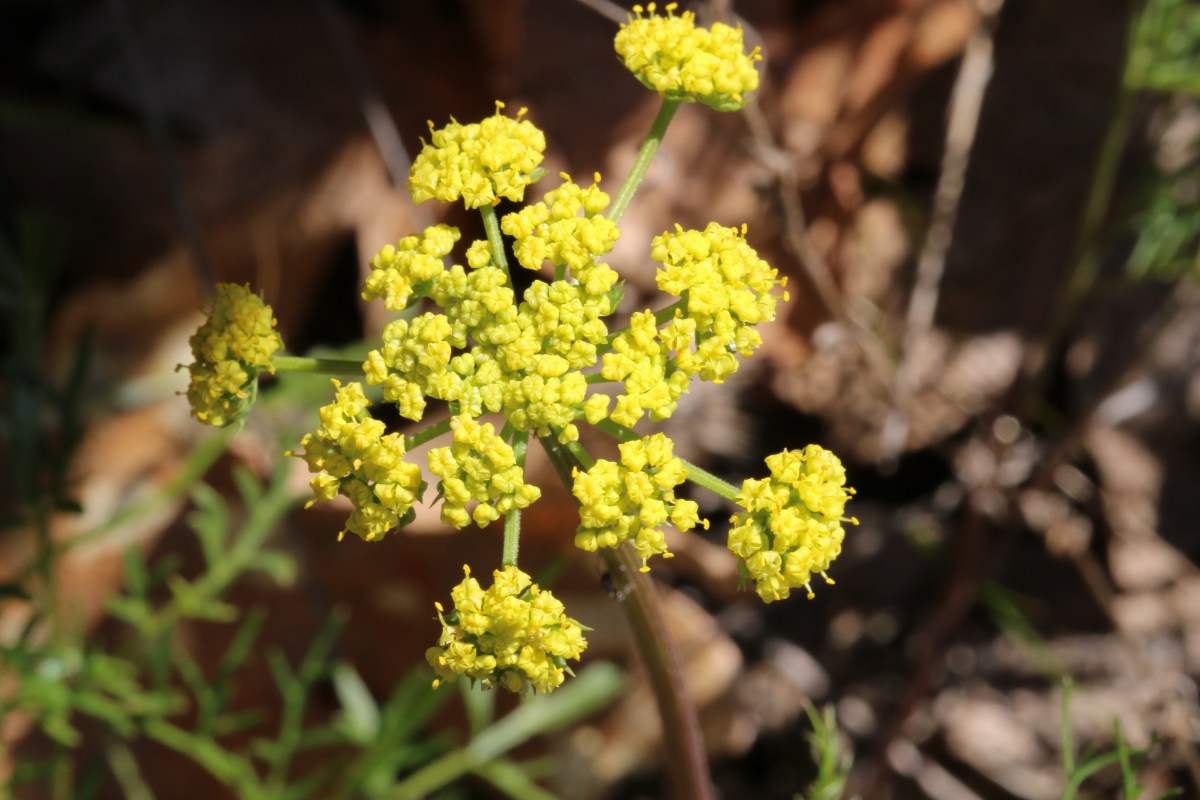
Description by the Native Plant Society of California. Lomatium utriculatum is a species of flowering plant in the carrot family known by the common name common lomatium. It is native to western North America from British Columbia to California, where it grows in many types of habitat. It is a hairless to lightly hairy perennial herb growing up to half a meter tall from a slender taproot. The leaves are basal and also grow from the middle and upper sections of the stem. Each is generally divided and subdivided into many small linear lobes. Leaves higher on the stem have prominent sheaths. The flower cluster is a webbed umbel of yellow flowers with rays up to 12 centimeters long.
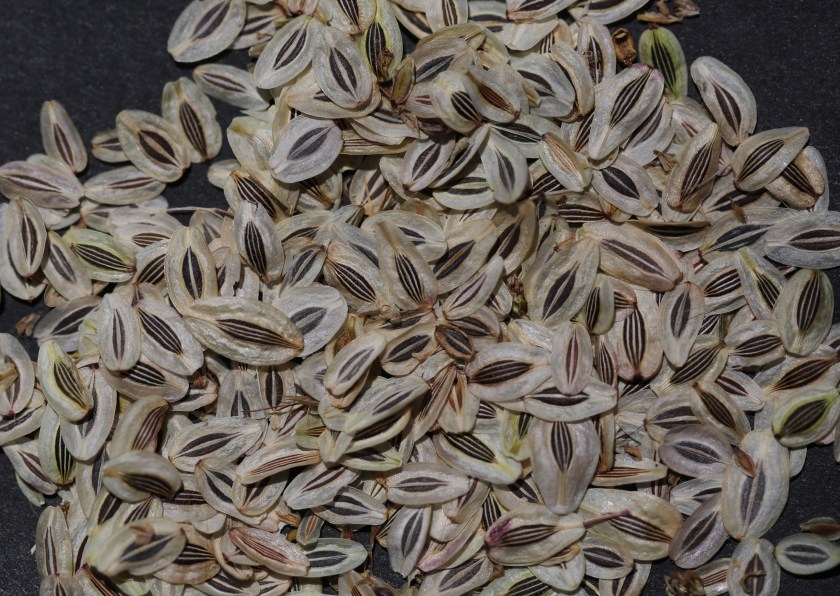
Lomatium utriculatum var. papillatum : this variety has small plants (30/35 cm high) and fruits roughening with bud-like one to several-celled papillae.
The pictures below are from a small population in the woods, one mile before the Ranger’s Station, along Upper Applegate Road close to the Californian border where the type was described by the botanist Henderson in 1931.




 Gaïan EthnoBotany