Fritillaria recurva

Ethnobotany. As mentioned in “Shasta Ethnography, Anthropological Records” (Holt, Catharine, 1946), the bulbs of Fritillaria recurva were boiled or roasted for food by the Shasta People.

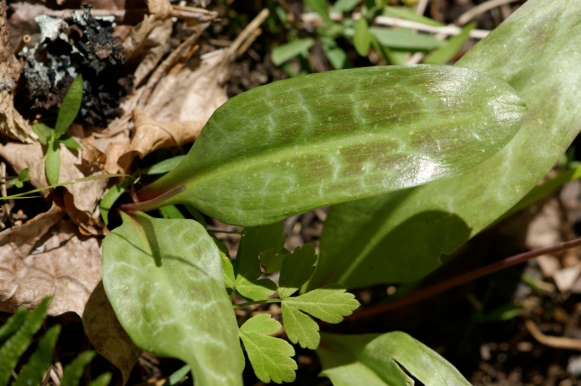
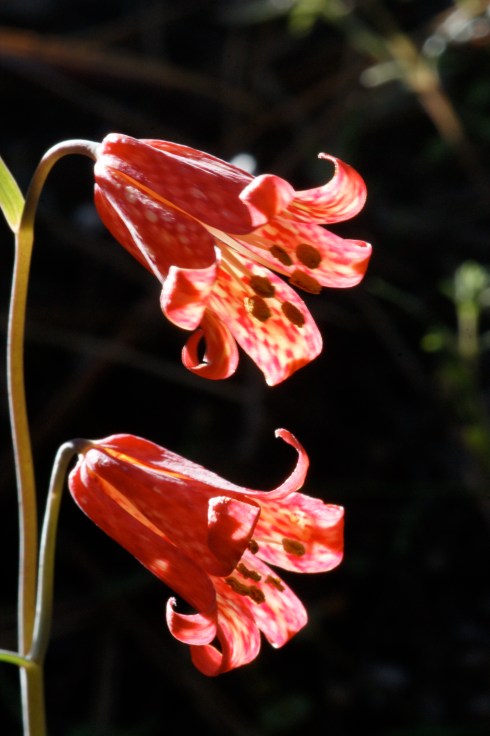
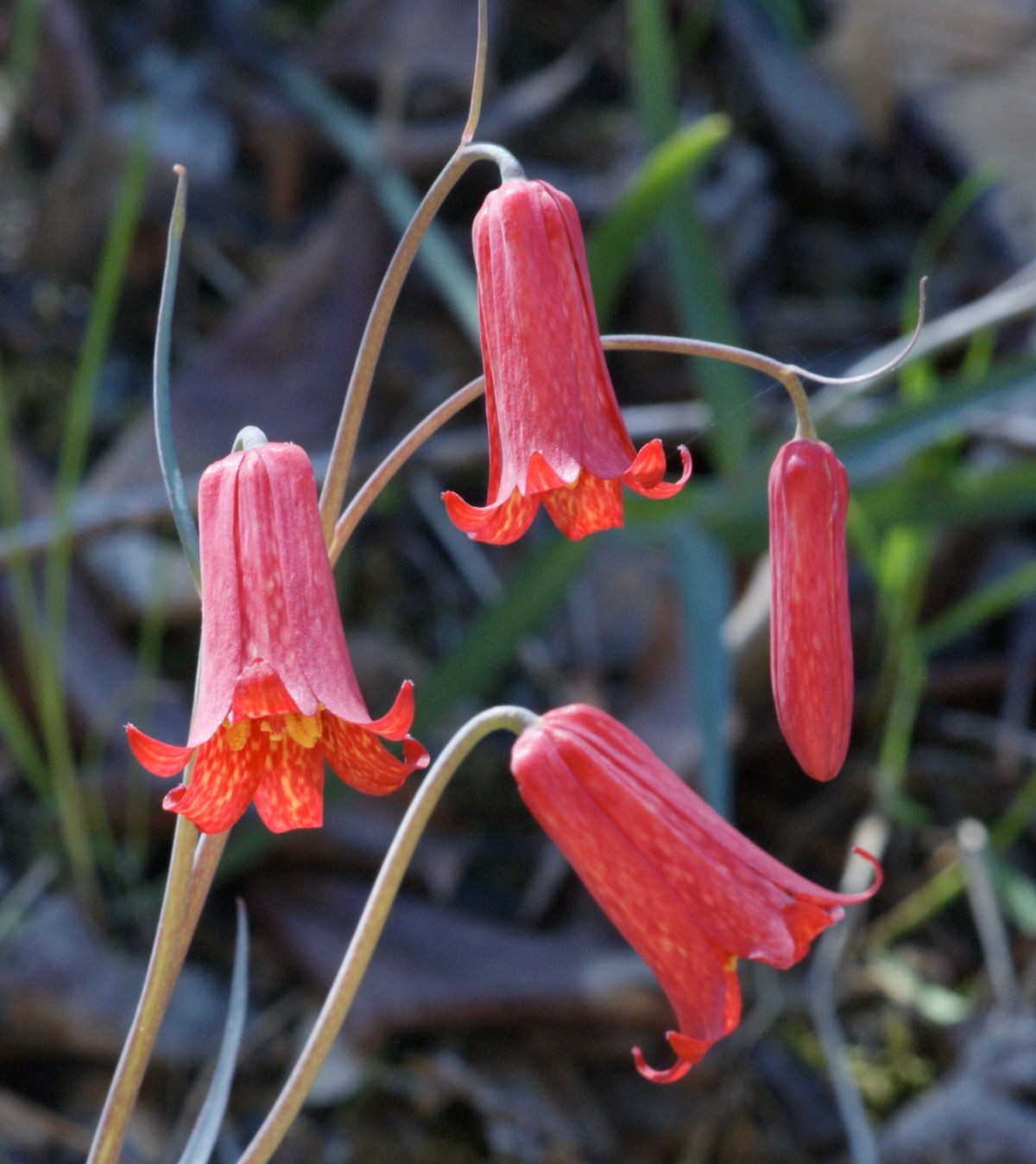
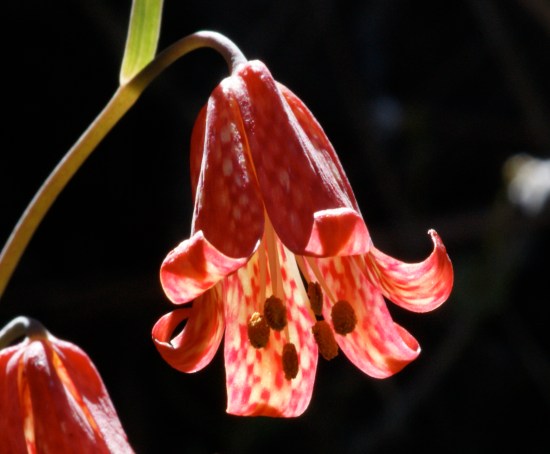
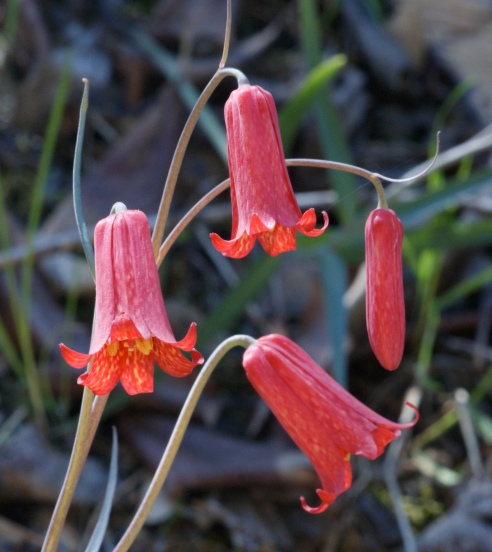
Description by the California Native Plants Society. Fritillaria recurva, the Scarlet Fritillary, is native to southwest Oregon from Douglas County south into California where it grows in the Klamath Mountains, Northern Coast Ranges, Cascade Range, and Sierra Nevada. It grows in dry, open woodlands and chaparral from 300 to 2200 meters, and it blooms in spring from February to July. Throughout its range it is distinguishable from other Fritillaria species by its scarlet red color, checkered with yellow on the inside, and recurved petals. Its leaves are arranged in whorls and are linear to narrowly lance-shaped. In southwest Oregon it is similar to the rare Fritillaria gentneri. The latter can be distinguished from Fritillaria recurva by its branching style and longer nectary glands. Additionally, it blooms about two weeks after Scarlet Fritillary and has a different reddish color.
SONY DSC
Fritillaria recurva 
SONY DSC
Fritillaria recurva 
SONY DSC
Fritillaria recurva
SONY DSC
Fritillaria recurva 

Fritillaria pudica

Ethnobotany. The bulbs of Fritillaria pudica were boiled or roasted for food by the Ute, Spokan, Thompson, Blackfoot, Flathead, Montana, Gosiute, Okanagan-Colville, Paiute and Shuswap Peoples. 

As mentioned in “The Salishan Tribes of the Western Plateaus” (Teit, James A., 1928); “Ethnobotany of the Blackfoot Indians, Ottawa” (Hellson, John C., 1974); “Montana Native Plants and Early Peoples, Helena” (Hart, Jeff, 1992); “The Ethno-Botany of the Gosiute Indians of Utah” (Chamberlin, Ralph V., 1911); Native Economic Plants of Montana, Bozeman” (Blankinship, J. W., 1905); “Ethnobotany of the Okanagan-Colville Indians of British Columbia and Washington, Victoria.” (Turner, Nancy J., R. Bouchard and Dorothy I.D. Kennedy, 1980); “Ethno-Botany of the Indians in the Interior of British Columbia” (Perry, F., 1952); “Ethnobotany of the Oregon Paiutes of the Warm Springs Indian Reservation” (Mahar, James Michael., 1953); “Shuswap Indian Ethnobotany” (Palmer, Gary, 1975); “Some Plant Names of the Ute Indians” (Chamberlin, Ralph V., 1909). The plant is called “skni” in the Sahaptin languages.

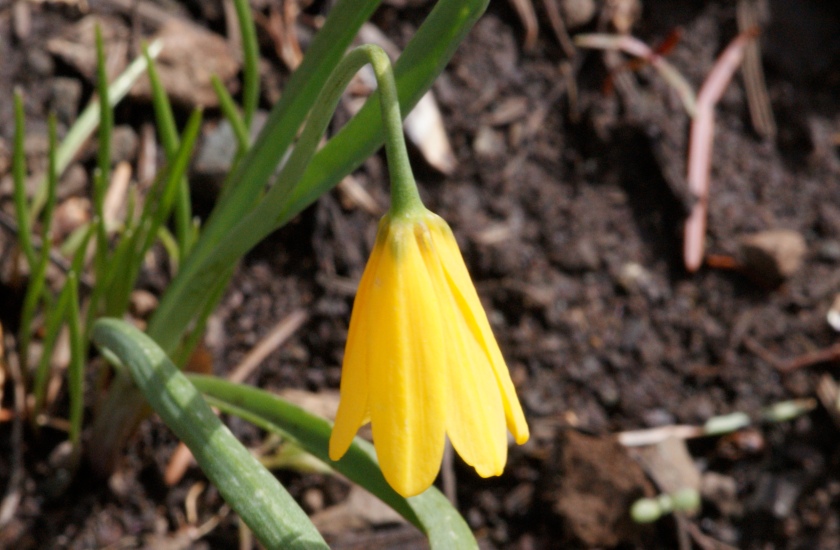
Description by the California Native Plants Society. Fritillaria pudica, (Yellow Fritillary) is a small, charming plant of sagebrush country in the western U.S. It is a member of the Lily family, or Liliaceae. Another (somewhat ambiguous) name is “yellowbells”, since it has a bell-shaped yellow flower. It may be found in dryish, loose soil; it is amongst the first plants to flower after the snow melts, but the flower does not last very long; as the petals age, they turn a brick-red colour and begin to curl outward. This lily produces a small bulb, which can be dug up and eaten fresh or cooked; it served Native Americans as a good source of food in times past, and is still eaten occasionally.

SONY DSC
Fritillaria pudica