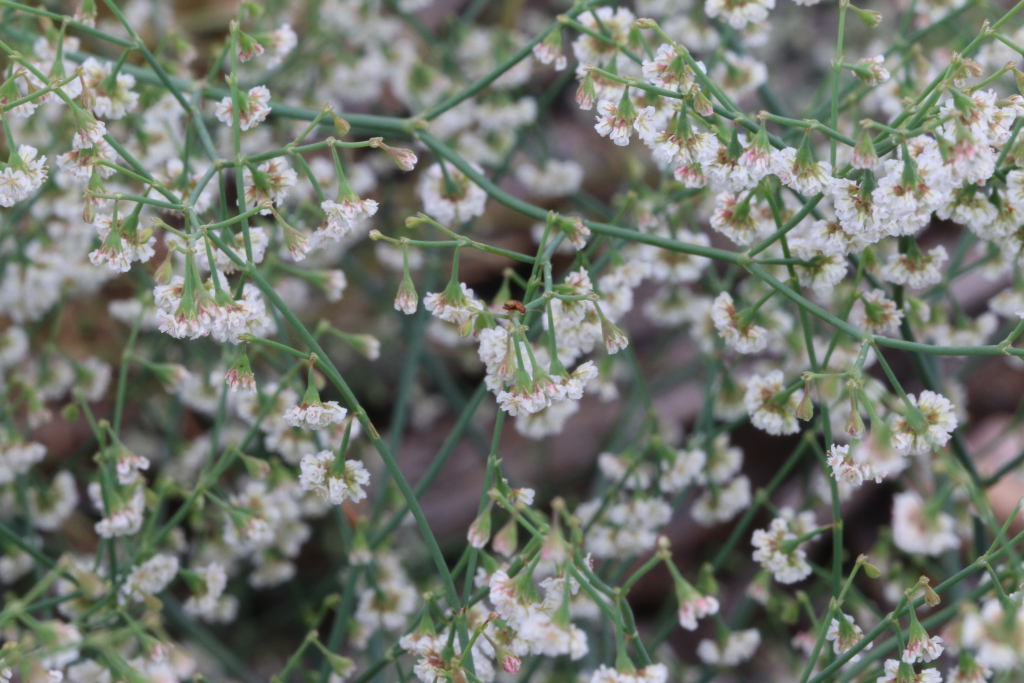
Ethnobotany. According to the book “The Ethnobotany of the Kayentah Navaho” (Wyman, Leland C. and Stuart K. Harris. The University of New Mexico Press. 1951), Eriogonum cernuum was used for skin rashes and for kidney diseases. The seeds were also made into a mush for food.
According to the book “The Ethnobotany of the Ramah Navaho” (Vestal, Paul A., 1952, Papers of the Peabody Museum of American Archaeology and Ethnology), Eriogonum cernuum was used as a poultice of chewed leaves applied to red ant bite.
According to the book “CRC World Dictionnary of Medicinal and Poisonous Plants” (Umberto Quattrocchi), Eriogonum cernuum was used also as a tonic and a antiseptic.
With the Gosiute Peoples of Nevada and Utah, Eriogonum cernuum is called “Oi’tcu-mo”, from Oi’tcu for bird and Mo’a for leg.
In the Bear Medicine of the Tewa (Pueblos) of New Mexico, Eriogonum cernuum – “poe unipi” – is used as a birth plant: a decoction of the plant is given after the birth. The other species used by the midwives are the following: Gilia rigidula; Phoradendron juniperum; Gutierrezia sarothrae; Croton texensis; Aquilegia caerulea; Dyssodia papposa; Euphorbia serpyllifolia; Mentzelia pumila; Asclepias latifolia; Malva parviflora.
In “Navajo Indian Medical Ethnobotany” (University of New-Mexico Bulletin. 1941) authored by Leland C. Wyman and Stuart K. Harris we find the following: Diseases (especially kidney and bladder disease, sudoresis, and stomach distress) attributed to swallowing a red ant (in food or water), or to other types of “red ant infection,” may be treated by Red Ant Way; hence plants used for these conditions may pertain to this Chant Way. Decoctions or infusions of the plants are taken internally and are said to “kill the ant.” Itching and sores caused by red ant bites are treated by applying decoctions or infusions as lotions, or by chewing the leaves of the plants and applying them as poultices. The plants may be designated by the Navajo names “red ant medicine” {1} “red ant killer” {2} “red ant food” {3} or included in the Navajo family or form genus “red ant decoction” {4}. See diuretics.
- {1} wóláchííʼ azee (c’il) – red ant medicine. Dyssodia accrosa; Dyssodia papposa; Gaura coccinea; Viguiera multiflora; Lepachys tagetes; Polygonum aviculare.
- {2} wóláchííʼ be-tkah – red ant killer: Grindelia aphanactis.
- {3} wóláchííʼ da – red ant food: Erlogonum cernum; Grindelia aphanactis; Androsacae septentrionalis, var. puberulenta var. glandulosa; Arenalia fendleri; Erigeron divergens; Euphorbia novomexicana; Oxybaphus spp.; Psilactis asterioides. Various botanical species of a “spidery” habit are often included in this group as generalizations, often being the same as those in the groups of “spider plants”. See {5} and {6}.
- {4} wóláchííʼ yiłbéézh – red ant decoction: Actinea leptoclada, var. ivesiana; Coreopsis cardaminefoiia; Corispermum hyssopifolium; Dyssodla accrosa; Eriogonum cernuum; Menodora scabra; Paronychia jamesii; Polygala alba; Silene pringlei; Tetraciea coulteri; Thelesperma longipes; Thelespermas ubnudum.
- {5} naʼashjéʼii c’il – spider plant: Androsacae septentrionalis var. puberulenta; Arenaria fendleri; Astragalus hosackiae; Hoffmanseggia drepanocarpa; Linum puberulum; Polygonum aviculare; Potentilla pennsylvanica; Potentilla propinqua.
- {6} naʼashjéʼii da – spider food: Androsacae septentrionalis var. puberulenta var. glandulosa; Boerhaavia sp.; Bouteloua eriopoda; Cladothryx lanuginosa: Galium fendleri; Gaura coccinea; Hoffmanseggia drepanocarpa; Petalostemum oligophyllum; (Vesicaria fendleri; Croton texensis) The last two groups include plants with a “spidery'” habit. Androsacae spp. may be.
Description from Jim Reveal’s Manual. Plants herbs, spreading to erect, annual, 0.5–6 dm tall, glabrous, grayish, greenish or reddish; stems with caudex absent, the aerial flowering stems erect, solid, not fistulose, 0.3–2 dm long, glabrous; leaves basal or sheathing up stems 2–10 cm, the petioles 1–4 cm long, tomentose, the blades round-ovate to orbiculate, (0.5) 1–2 (2.5) cm long and wide, white- to grayish-tomentose abaxially, tomentose to floccose or glabrate and grayish or greenish adaxially, the margins plane; inflorescences cymose, open to diffuse, 5–50 cm long, 5–40 cm wide, the branches glabrous, the bracts 3, scalelike, 1–2 mm long, 1–2.5 mm wide; peduncles spreading to ascending or deflexed to cernuous, infrequently absent, straight or curved, slender, 0.1–2.5 cm long, glabrous; involucres turbinate, (1) 1.5–2 mm long, 1–1.5 mm wide, glabrous, the teeth 5, erect, 0.4–0.7 mm long; flowers 1–2 mm long, glabrous, the perianth white to pinkish, becoming rose to red, the tepals dimorphic, those of outer whorl pandurate, those of inner whorl obovate, the stamens mostly exserted, 1–2 mm long, the filaments pilose proximally; achenes light brown to brown, trigonous, 1.5–2 mm long, glabrous.

 Gaïan EthnoBotany