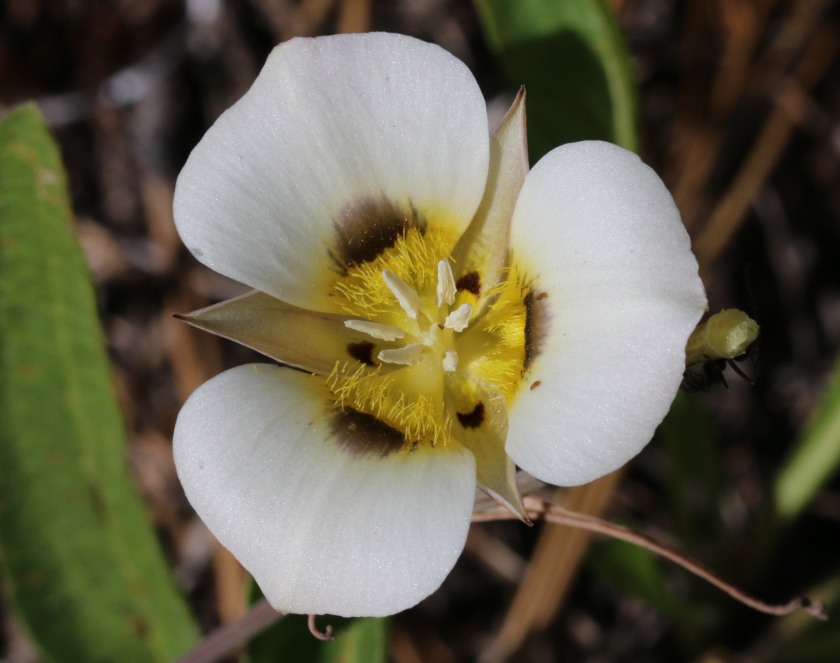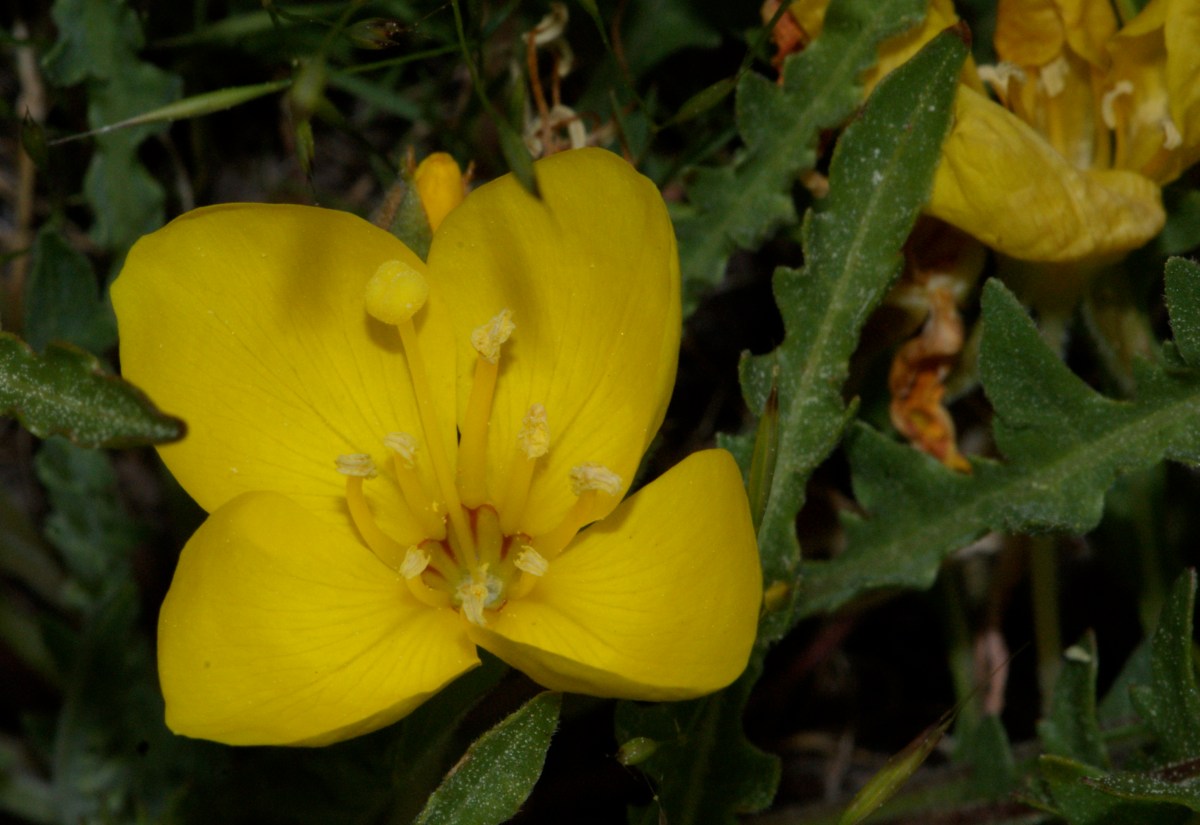
Oenothera flava

Ethnobotany. It was a medicinal plant among the Navajo-Ramah who used the seed pod ashes applied to burns. They called it a “life-medicine” and used poultices of plant or root or large swellings, internal injuries and throat troubles. As mentioned in “The Ethnobotany of the Ramah Navaho”, Papers of the Peabody Museum of American Archaeology and Ethnology 4. Vestal, Paul A., 1952.

Description from the Jepson. Herbaceous, low-growing perennials, stems absent, herbage minutely strigose with glandular hairs, plants from fleshy taproots. Leaves: Alternate, sessile, fleshy, in basal rosettes, oblanceolate to oblong in outline and irregularly pinnately lobed, 3-36 cm long. Flowers: Yellow fading pale orange, large and showy with 4 notched petals with rounded lobes 10-38 mm long, sepals 10-34 mm long, the free tips in bud 1-5 mm long, hypanthium 24-150 mm long, flowers borne in axils. Fruits: Narrowly ovate to elliptic, loculicidal capsules, 10-40 mm long and 4-7 mm wide, with wings 2-6 mm wide. Seeds obliquely wedge-shaped, 1-2.5 mm long, minutely beaded and narrow-winged distally and along 1 margin. Ecology: Found on clay soils in drying depressions, damp flats, meadows, streambanks, and sagebrush scrub to pi-on/juniper woodland communities, from 2,500-9,000 ft (762-2743 m); flowering April-September. Distribution: Occurring mainly in the western half of the United States, including Arizona, California, Nevada, New Mexico, Texas, and Utah, also in Mexico. Notes: This Oenothera has bright yellow flowers that fade pinkish, and leaves which are highly variable in shape. A handy key for this species is the length of the tips of the sepals in bud, they are 1-5 mm long in this species, and less than or to 1 mm long in Oenothera deltoides.
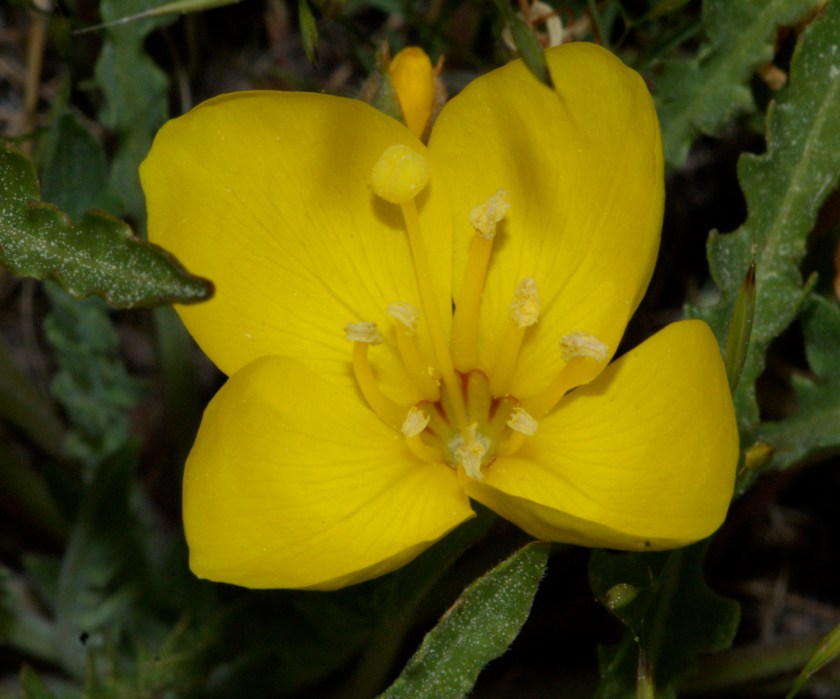
SONY DSC
Oenothera flava 
SONY DSC
Oenothera flava 

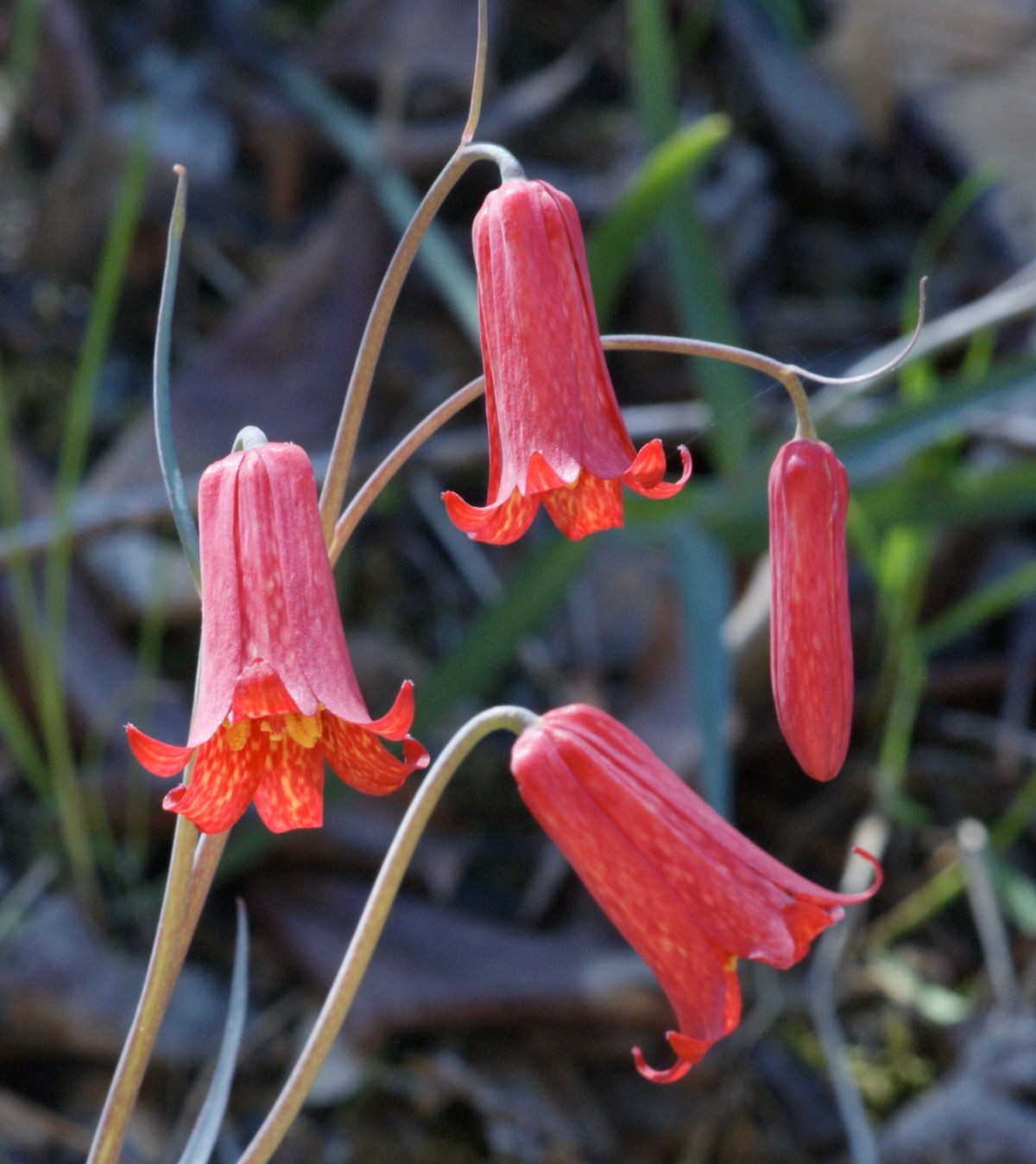
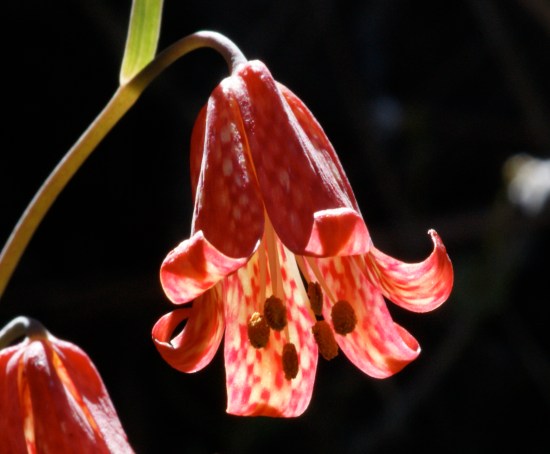
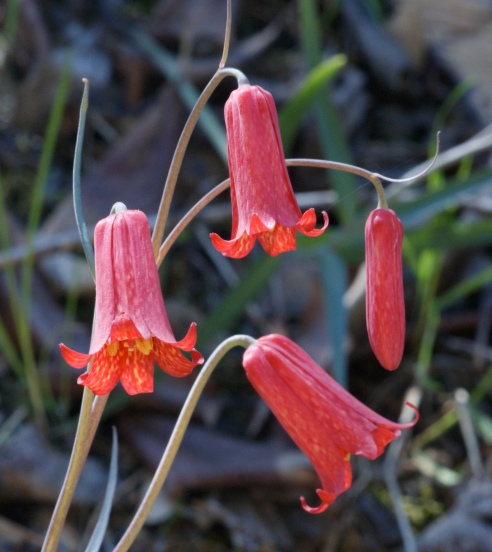
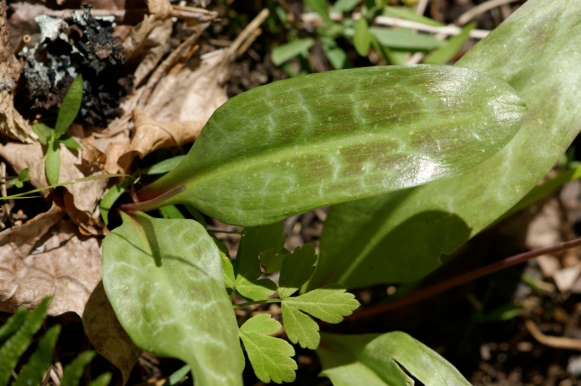
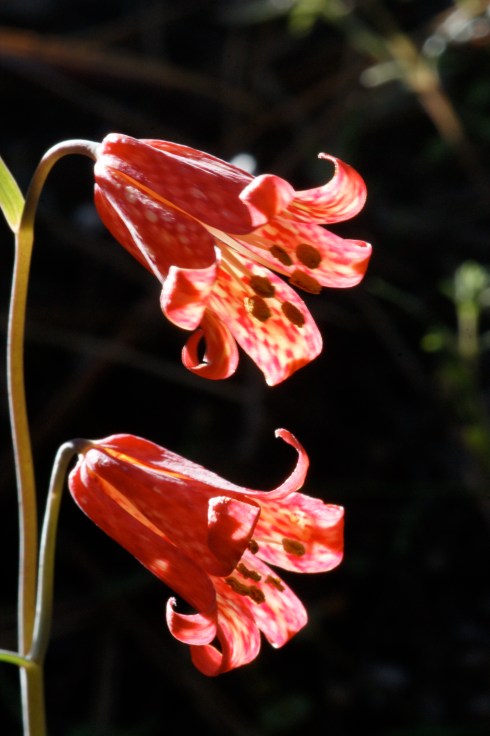
Fritillaria recurva

Ethnobotany. As mentioned in “Shasta Ethnography, Anthropological Records” (Holt, Catharine, 1946), the bulbs of Fritillaria recurva were boiled or roasted for food by the Shasta People.

Description by the California Native Plants Society. Fritillaria recurva, the Scarlet Fritillary, is native to southwest Oregon from Douglas County south into California where it grows in the Klamath Mountains, Northern Coast Ranges, Cascade Range, and Sierra Nevada. It grows in dry, open woodlands and chaparral from 300 to 2200 meters, and it blooms in spring from February to July. Throughout its range it is distinguishable from other Fritillaria species by its scarlet red color, checkered with yellow on the inside, and recurved petals. Its leaves are arranged in whorls and are linear to narrowly lance-shaped. In southwest Oregon it is similar to the rare Fritillaria gentneri. The latter can be distinguished from Fritillaria recurva by its branching style and longer nectary glands. Additionally, it blooms about two weeks after Scarlet Fritillary and has a different reddish color.

SONY DSC
Fritillaria recurva 
SONY DSC
Fritillaria recurva 
SONY DSC
Fritillaria recurva
SONY DSC
Fritillaria recurva 

Erythranthe alsinoides

Ethnobotany. Many other species in the genus Mimulus (where it belonged before) were used as food or as medicine by the First People.

Description. From the University of Washington. Annual, glandular-hairy to somewhat glabrous (smooth), growing to 0.5-3 dm. in height. The plants are slender, and have either a simple or freely-branching form. Often found growing in uniformly dense patches. The stems frequently appear somewhat reddish. Leaves: Opposite, slightly to evidently-toothed, 3-5 prominent veins on the upper surface. The blades are 0.5-2.5 cm. long, with a petiole of more or less equal length. Flowers: The yellow corollas fuse to form an upper and lower lip (bilabiate), and grow 8-14 mm. long. A conspicuous reddish-brown blotch is found on the lower and sometimes the upper lip. Individual flowers are attached to the stem by a long pedicel. Fruit: Capsule.
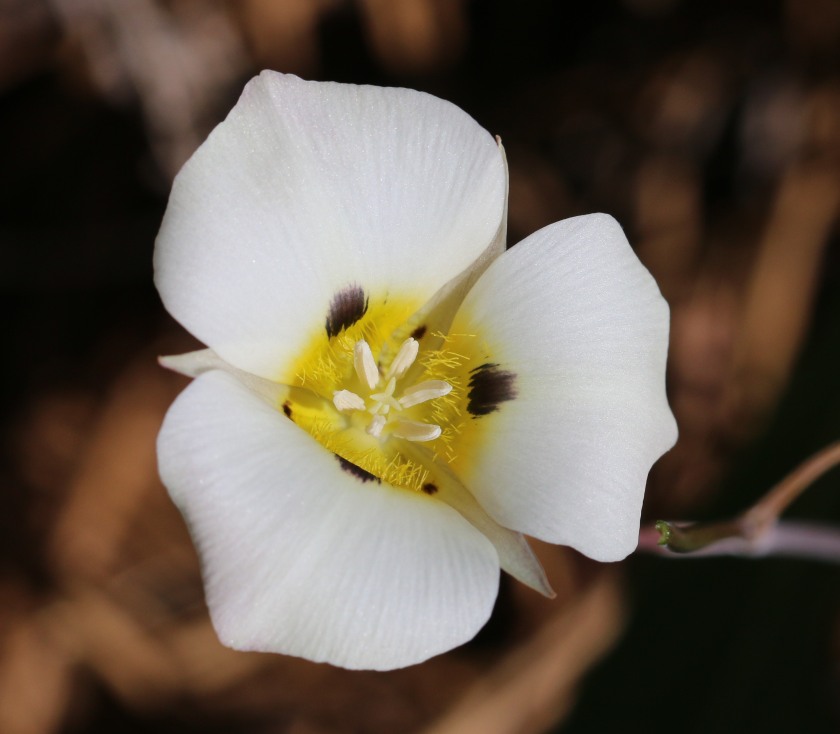
Distinguishing Characteristics: The reddish-brown blotch on the lower lip is very diagnostic along with its annual life cycle and tendency to be found in moss mats. The middle lobe of the lower lip tends to be the longest and somewhat curved backwards (deflexed). The lower two teeth of the calyx tend to be more rounded and longer than the upper three calyx teeth.
SONY DSC
Erythranthe alsinoides
SONY DSC
Erythranthe alsinoides

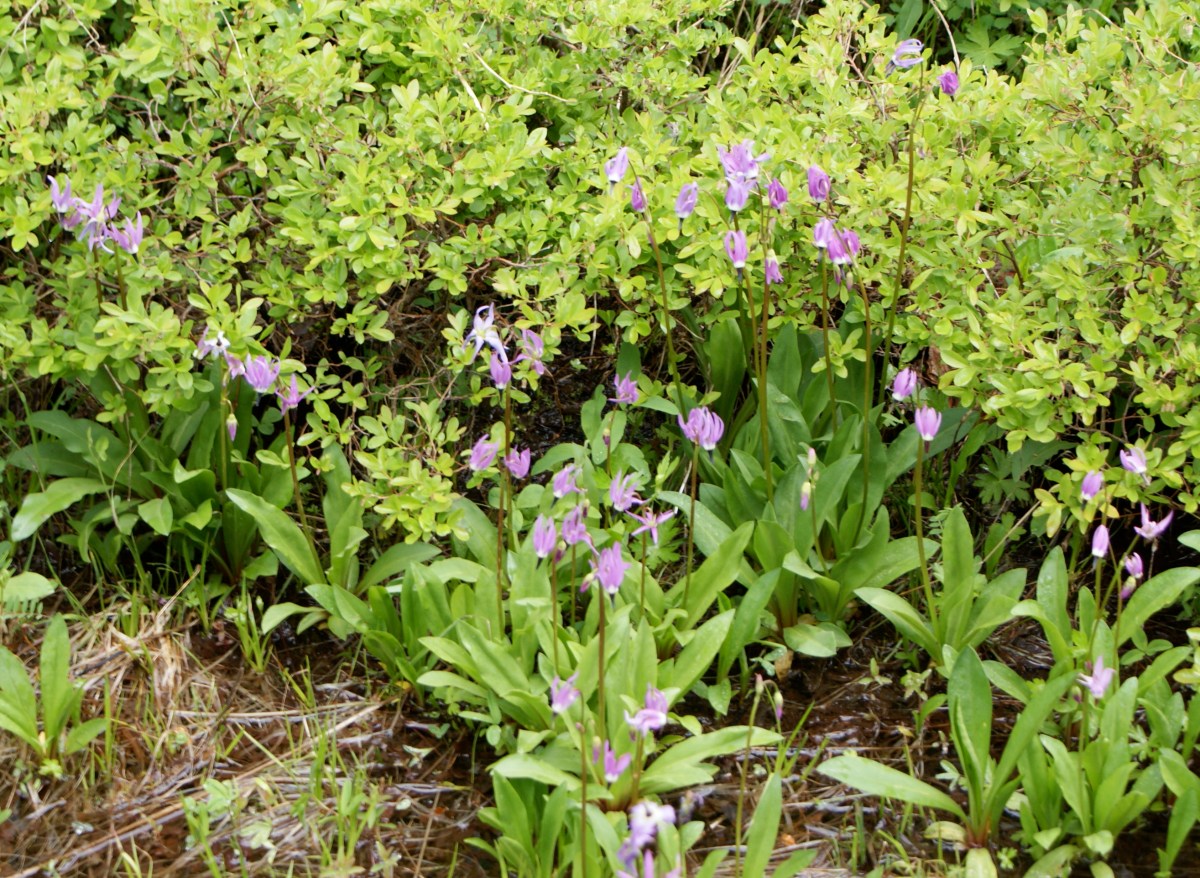
Primula jeffreyi

Ethnobotany. With the Thompson People, the flowers were used by women «to obtain the love of men and to help them control men or were used as a charm «to obtain wealth & to make people give presents.» As mentioned in “The Ethnobotany of the Thompson Indians of British Columbia”. Steedman, E.V., 1928.

Description par Jim Reveal. Plants 1–6(–7.5) dm, glandular-pubescent at least in part, not sticky.  Caudex not obvious at anthesis or more commonly short, thick, generally horizontal, occasionally stout, elongate and horizontal; roots generally white; bulblets absent.  Leaves (2.5–) 7–40(–53) ´ (0.5–) 1–6(–7.5) cm, decurrent to base; blade usually gradually tapering to a winged petiole, narrowly oblanceolate or more commonly broader to spatulate, glabrous or glandular-pubescent, margins entire or crenate to serrulate.  Inflorescences 3–20-flowered; bracts lanceolate to broadly lanceolate, 3–17 mm; pedicels 2–7 cm at anthesis, glandular-pubescent, rarely glabrous.  Flowers 4–5-merous; calyx 7–12(–15) mm, glandular-pubescent, rarely glabrous, tube 2–4 mm, lobes 4.5–8(–12) mm; corolla lobes 1–2.5(–2.7) cm, magenta to lavender or light yellow to whitish, tube cream or (rarely) yellow with a thin to thick, often wavy, reddish to purplish ring, ring rarely absent; filaments free or partially fused, usually 1–1.5 mm, dark maroon to black; anthers 6.5–11 mm, truncate to obtuse apically, pollen sacs yellow or maroon, connective rugose, purplish; stigma enlarged by no more than twice diameter of style.  Capsules ovoid, 7–11(–15) ´ 4.5–7(–10) mm, yellowish-tan to reddish brown, glabrous or teeth occasionally sparsely glandular-puberulent, operculate or valvate, occasionally both on same plant; walls thin.  2n = 42, 44, 66, 86. Flowering summer. Dry to moist stream banks, lakeshores, bogs, and meadows mainly in montane conifer woodlands; 0–3000 m; B.C.; Alaska; Calif., Idaho, Mont., Oreg., Wash., Wyo.

Tall mountain shootingstar is found in widely scattered montane places in the Sierra Nevada of California and extreme western Nevada and on the northern coastal ranges and Siskiyou Mountains of northern California and southwestern Oregon. The species occurs northward in the Cascade Ranges of Oregon, Washington and British Columbia to the Kenai Peninsula region of south central Alaska, often near the coast especially on many of the off-shore islands. Inland in the United States the plant is widely scattered in the mountains of northeastern Oregon, central and northern Idaho, and western Montana. Isolated stations occur on the Olympic Peninsula of Washington. A single collection (J. Major 2927, GTNP) from Moose Basin, Grand Teton National Park, is the only record from Wyoming.

Primula jeffreyi is usually readily recognized, but in portions of California, the Primula redolens can be somewhat arbitrary. Whether this is a breakdown of species boundaries due to hybridization or a shift in their respective morphologies due to overlapping ecological settings is uncertain. At least in a few instances, intermediate plants seem to occur in areas where two of the species occur in close proximity. In general, the corolla tube of Primula jeffreyi is white except near the ring where it is yellow. In Primula redolens, the entire corolla tube is yellow.

Reference Books. Revision of Dodecatheon. James Reveal. 

SONY DSC
Dodecatheon jeffreyi

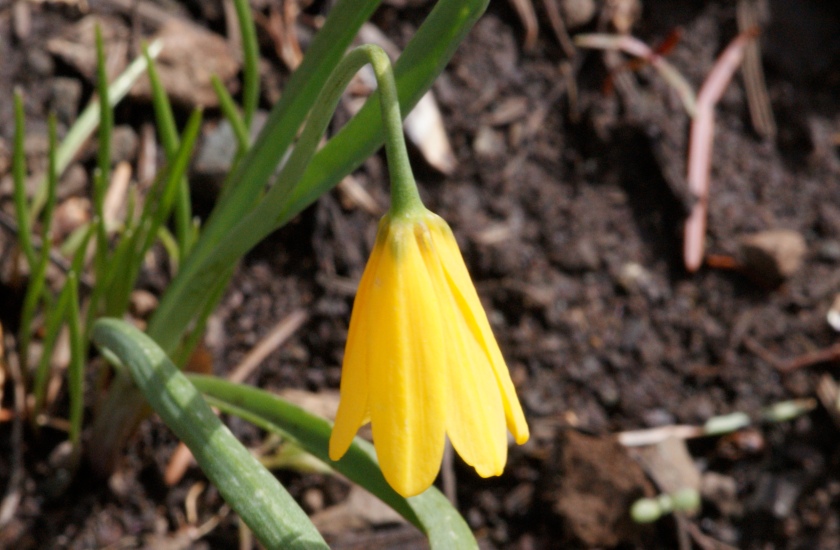
Fritillaria pudica

Ethnobotany. The bulbs of Fritillaria pudica were boiled or roasted for food by the Ute, Spokan, Thompson, Blackfoot, Flathead, Montana, Gosiute, Okanagan-Colville, Paiute and Shuswap Peoples. 

As mentioned in “The Salishan Tribes of the Western Plateaus” (Teit, James A., 1928); “Ethnobotany of the Blackfoot Indians, Ottawa” (Hellson, John C., 1974); “Montana Native Plants and Early Peoples, Helena” (Hart, Jeff, 1992); “The Ethno-Botany of the Gosiute Indians of Utah” (Chamberlin, Ralph V., 1911); Native Economic Plants of Montana, Bozeman” (Blankinship, J. W., 1905); “Ethnobotany of the Okanagan-Colville Indians of British Columbia and Washington, Victoria.” (Turner, Nancy J., R. Bouchard and Dorothy I.D. Kennedy, 1980); “Ethno-Botany of the Indians in the Interior of British Columbia” (Perry, F., 1952); “Ethnobotany of the Oregon Paiutes of the Warm Springs Indian Reservation” (Mahar, James Michael., 1953); “Shuswap Indian Ethnobotany” (Palmer, Gary, 1975); “Some Plant Names of the Ute Indians” (Chamberlin, Ralph V., 1909). The plant is called “skni” in the Sahaptin languages.

Description by the California Native Plants Society. Fritillaria pudica, (Yellow Fritillary) is a small, charming plant of sagebrush country in the western U.S. It is a member of the Lily family, or Liliaceae. Another (somewhat ambiguous) name is “yellowbells”, since it has a bell-shaped yellow flower. It may be found in dryish, loose soil; it is amongst the first plants to flower after the snow melts, but the flower does not last very long; as the petals age, they turn a brick-red colour and begin to curl outward. This lily produces a small bulb, which can be dug up and eaten fresh or cooked; it served Native Americans as a good source of food in times past, and is still eaten occasionally.

SONY DSC
Fritillaria pudica

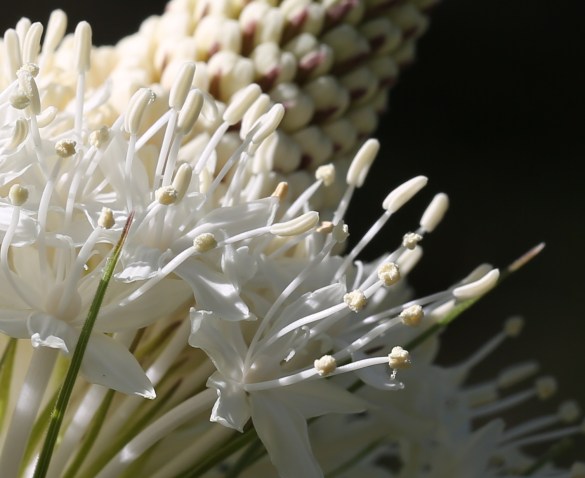
Xerophyllum tenax

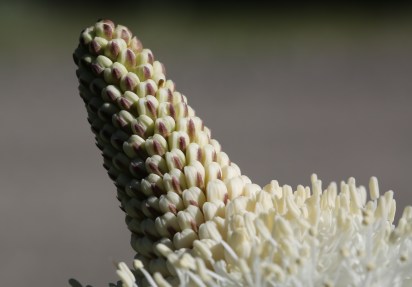
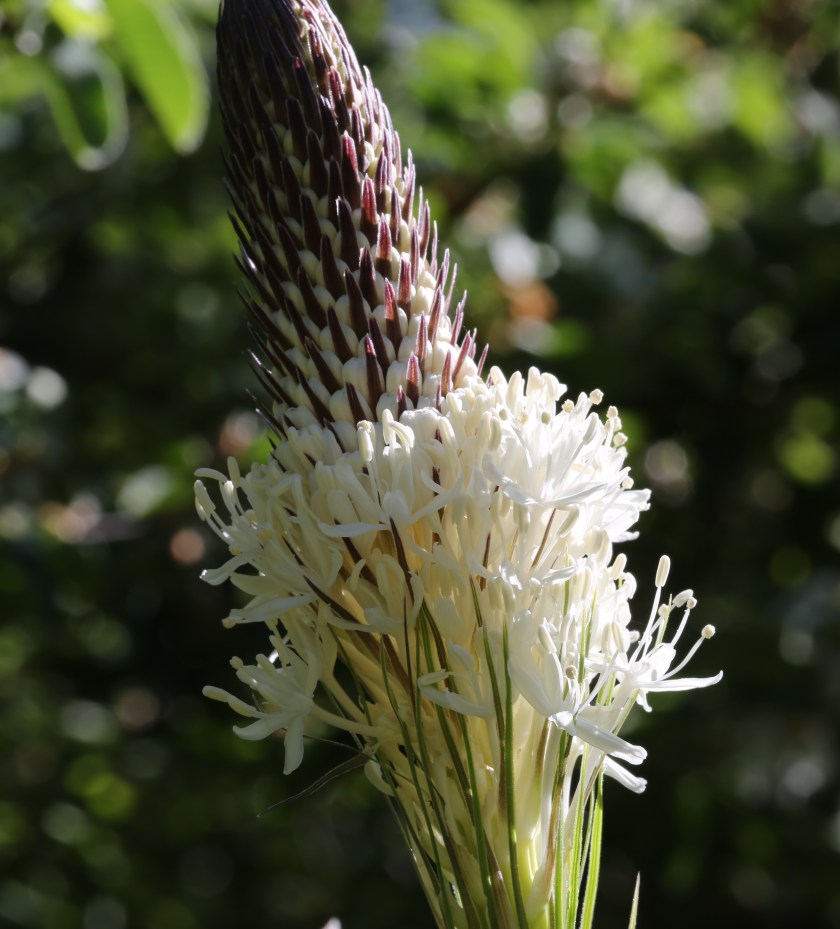
Ethnobotany. This plant was used by many First Peoples: Blackfoot, Chehalis, Cowlitz, Hesquiat, Hoh, Hupa, Karok, Klallam, Maidu, Makah, Montana, Nitinaht, Okanagan-Colville, Pomo, Quileute, Quinault, Yama, Yurok. Poultices of chewed roots were applied to wounds, breaks and sprains. The plants used to decorate baskets and garments. The leaves were woven into water tight baskets used for cooking. The bulbous rhizomes were roasted for several days before being eaten.

Description from the Flora of America. Stems (0.8–)1.2–1.8(–2) m. Leaf blade 2–8(–10) dm × 2–4(–6) mm. Racemes 5–7 dm. Tepals oblong to lanceolate, 6–9 × 2–3 mm; styles 4 mm. Capsules 5–7 mm. Seeds 4 per locule. 2n = 30. Flowering spring–early summer. Open coniferous woods, dry ridges, rocky slopes, and clearings; 0–2300 m; Alta., B.C.; Calif., Idaho, Mont., Oreg., Wash., Wyo.

Xerophyllum tenax 11

Xerophyllum tenax 10

Xerophyllum tenax 07

Xerophyllum tenax 05

Xerophyllum tenax 03

Xerophyllum tenax 09

Xerophyllum tenax 08

Xerophyllum tenax 04

Xerophyllum tenax 01

Calochortus gunnisonii

Ethnobotany. A food and a medicine for many Amerindian Peoples. Calochortus gunnisonii was a food for the following First Peoples: Keres, Cheyenne, Navajo Ramah. Among the Navajo Ramah, the juice of the leaves was applied to pimples; a decoction of the whole plant was taken to ease delivery of placenta; and the plant was also used a ceremonial medicine. Among the Keres, an infusion of the was plant taken for swellings. Among the Cheyennes, the dried and chopped bulbs were used as an ingredient for a medicinal mixture. These informations were mentioned in: “The Ethnobotany of the Ramah Navaho”; “The Cheyenne Indians – Their History and Ways of Life Vol 2”; “The Ethnobotany of the Northern Cheyenne Indians of Montana”.

Description from the Flora of America. Calochortus gunnisonii. Plants usually bulbose; bulb coat, when present, membranous. Stems not branching, straight, 2.4–5.5 dm. Leaves: basal withering, 18–35 cm; blade linear. Inflorescences subumbellate, 1–3-flowered. Flowers erect; perianth open, campanulate; sepals marked similar to petals, lanceolate, usually much shorter, glabrous, apex acute; petals white to purple, greenish adaxially, clawed, often with narrow, transverse purple band distal to gland and purple blotch on claw, obovate, cuneate, usually obtuse and rounded distally; glands transversely oblong, not depressed, densely bearded with distally branching hairs, outermost of which somewhat connate at base to form discontinuous, deeply fringed membranes; filaments shorter than anthers; anthers lanceolate, apex acute to apiculate. Capsules erect, linear-oblong, 3-angled, 3–6 cm, apex acute. Seeds flat, inflated. 2n = 18.usually bulbose

Reference Books. The gem of a book for all Calochortus aficionados is : “Calochortus Mariposa Lilies and their Relatives”. By Mary E. Gerritsen and Ron Parsons. 2007. Timber Press. 

SONY DSC
Calochortus gunnisonii in Mesa Verde

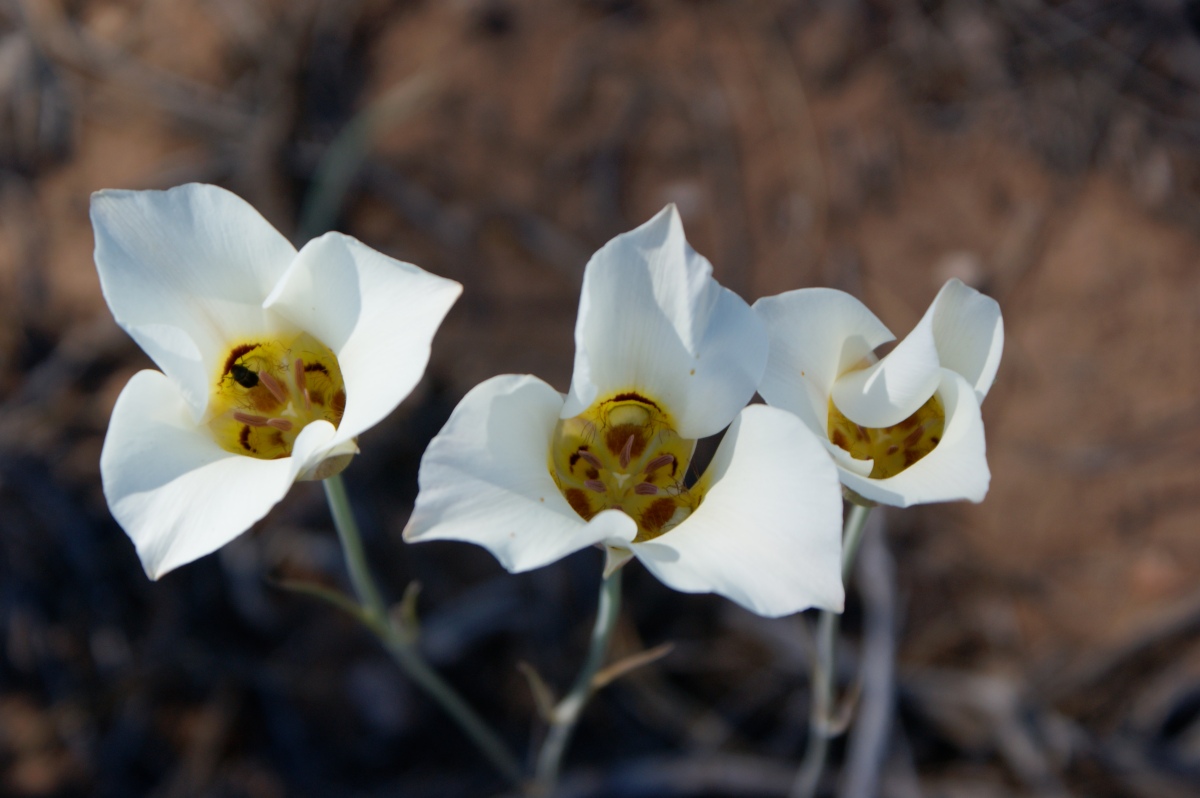
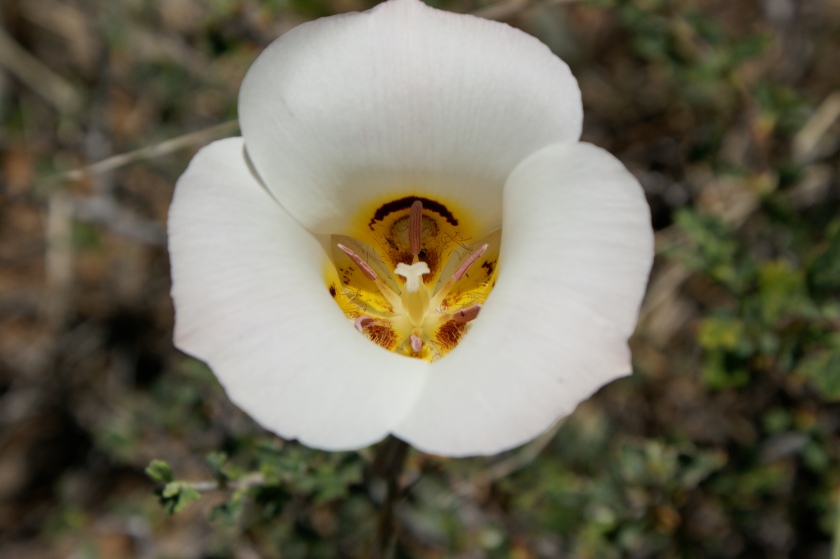
Calochortus nuttallii

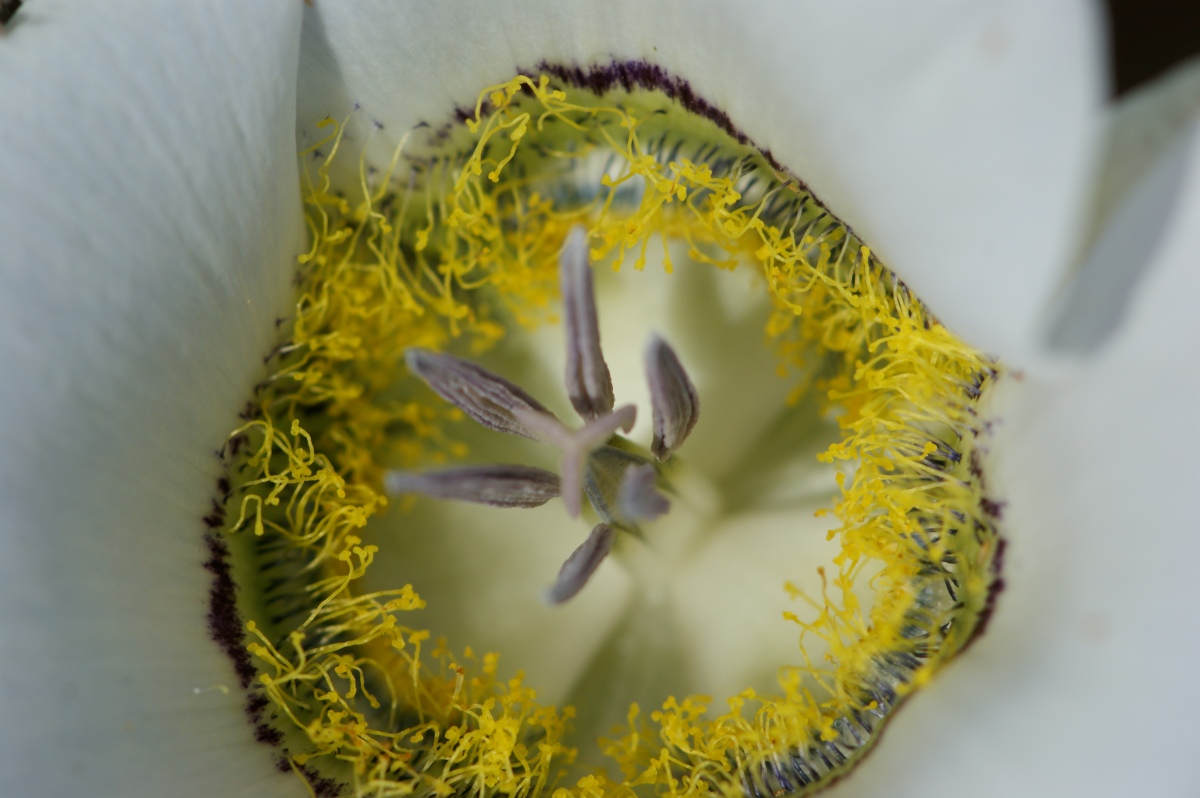
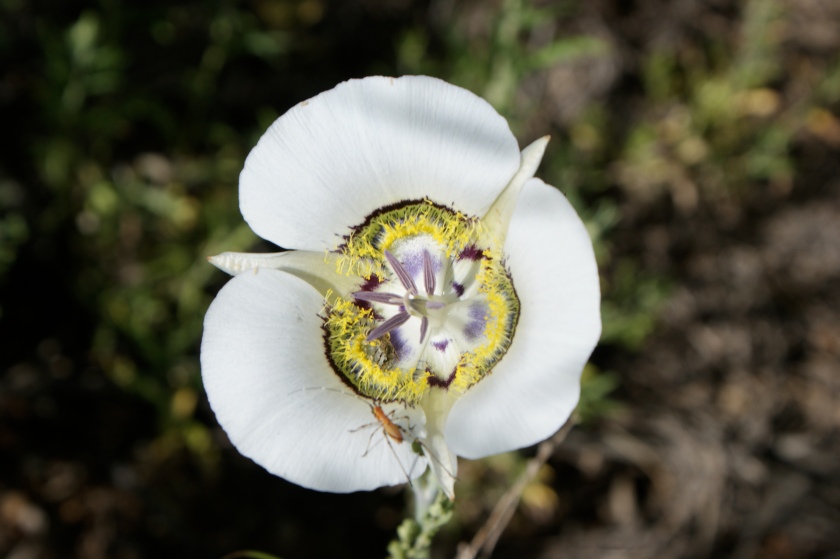
Ethnobotany. A food and a medicine for many Amerindian Peoples: the bulbs were eaten raw or roasted. Calochortus nuttallii was a food for the following First Peoples: Hopi, Gosiute, Navajo, Havasupai, Ute et Païute. These informations were mentioned in “Willards Z. Park’s Ethnographic Notes on the Northern Paiute of Western Nevada 1933-1940”; “Indian Uses of Native Plants”; “Some Plant Names of the Ute Indians, American Anthropologist”; “Some Data on Plains and Great Basin Indian Uses of Certain Native Plants, Tebiwa”; “Ethnobotany of the Navajo”; “Hopi History And Ethnobotany”; “Havasupai Habitat: A. F. Whiting’s Ethnography of a Traditional Indian Culture”; “The Ethno-Botany of the Gosiute Indians of Utah, Memoirs of the American Anthropological Association”.

Kate C. Snow, President of the Daughters of Utah Pioneers, in a letter dated April 17, 1930, says that “between 1840 and 1851” food became very scarce in Utah due to a crop-devouring plague of crickets, and that “the families were put on rations, and during this time they learned to dig for and to eat the soft, bulbous root of the sego lily. The memory of this use, quite as much as the natural beauty of the flower, caused it to be selected in after years by the Legislature as the floral emblem of the State. By an act of the Utah State Legislature, approved on March 18, 1911, the sego lily was declared to be the State floral emblem. The sego lily was made the official state flower after a census was taken of the state’s school children as to their preference for a state flower.

Description by P. L. Fiedler & R. K. Zebell in Flora of North America (vol. 26)Plants usually bulbose; bulb coat, when present, membranous. Stems usually not branching or twisted, straight, 1.5-4.5 dm. Leaves: blade linear, becoming involute; basal withering. Inflorescences subumbellate, 1-4-flowered; bracts congested, unequal. Flowers erect; perianth open, campanulate; sepals marked similar to petals, usually shorter, lanceolate, glabrous, apex acuminate; petals white, tinged with lilac or infrequently magenta, yellow at base, with reddish brown or purple band or blotch distal to gland, broadly obovate, cuneate, sparsely invested near gland with slender hairs, apex usually short-acuminate; glands round, depressed, surrounded by conspicuously fringed membrane, densely covered with short, unbranched or distally branching hairs; filaments ca. equaling anthers; anthers yellowish or pinkish, oblong, apex obtuse. Capsules erect, linear-lanceoloid, 3-angled, apex acuminate. Seeds flat. 2n = 16. Flowering late spring–late summer. Dry soils; 700–3300 m; Ariz., Colo., Idaho, Mont., Nebr., Nev., N.Mex., N.Dak., S.Dak., Utah, Wyo.

Reference Books. The gem of a book for all Calochortus aficionados is : “Calochortus Mariposa Lilies and their Relatives”. By Mary E. Gerritsen and Ron Parsons. 2007. Timber Press. 

SONY DSC
Calochortus nuttallii in Mesa Verde.

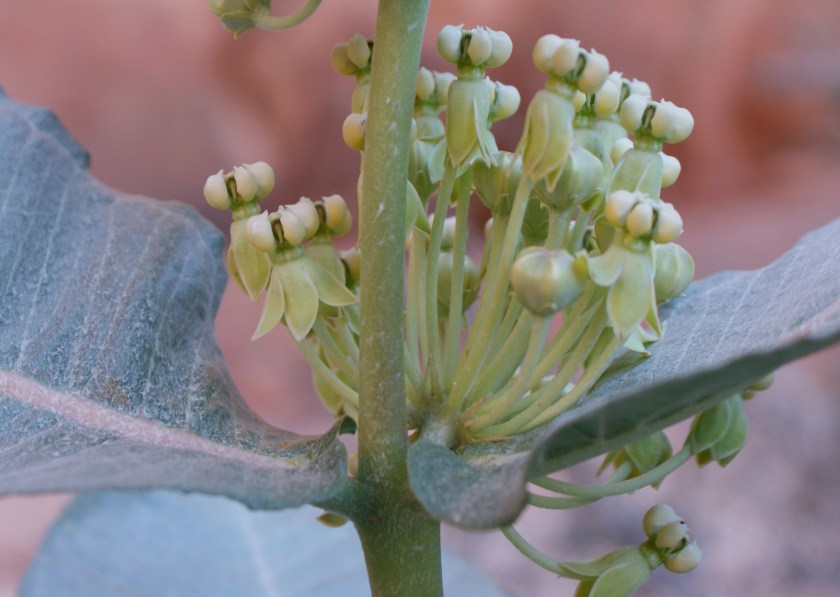
Asclepias latifolia

Ethnobotany. The Isleta People used the ground leaf and stem powder to be inhaled for catarrhs as mentioned in “The Ethnobotany of the Isleta Indians”. Jones, Volney H. 1931, University of New Mexico.

Description. Plant: perennial herb; stems erect or ascending, unbranched, 20-80 cm tall, short woolly to more or less glabrate; milky sap Leaves: opposite, subsessile or the petioles to 10 mm long, the blades nearly circular to mostly broadly elliptic, 5-14 cm long, 4-12 cm broad, broadly rounded to subcordate at the base, broadly rounded to truncate or retuse at the apex, apiculate, short woolly when young, in age more or less glabrate on both surfaces Inflorescence: Umbels lateral at most of the upper nodes, persistently short woolly, (4-)5-8 cm broad, subsessile or the peduncles to 2(-3) cm long Flowers: large; calyx lobes ca. 4 mm long; corolla greenish, the lobes 7-10 mm long; hoods whitish to yellow-brown, erect or uncommonly ascending, mostly oblong-quadrate, truncate at the apex, 3-4 mm high, 2-3 mm broad, about as long as the gynostegium, the horns radially flat, fused nearly the full length of the hoods, triangular to sickle-shaped, abruptly incurved and short-exserted; anther wings 2.7-3.2 mm long; corpusculum 0.4-0.5 mm long, the pollinia 1.7-1.9 mm long Fruit: Follicles erect on deflexed pedicels, 7-9 cm long Misc: Canyons and rocky slopes, desert grasslands, spreading to roadsides; 750-2150 m (2500-7000 ft); Jun-Sep. Source: Asclepiadaceae. Eric Sundell. 1993.

SONY DSC
Asclepias latifolia
SONY DSC
Asclepias latifolia
SONY DSC
Asclepias latifolia


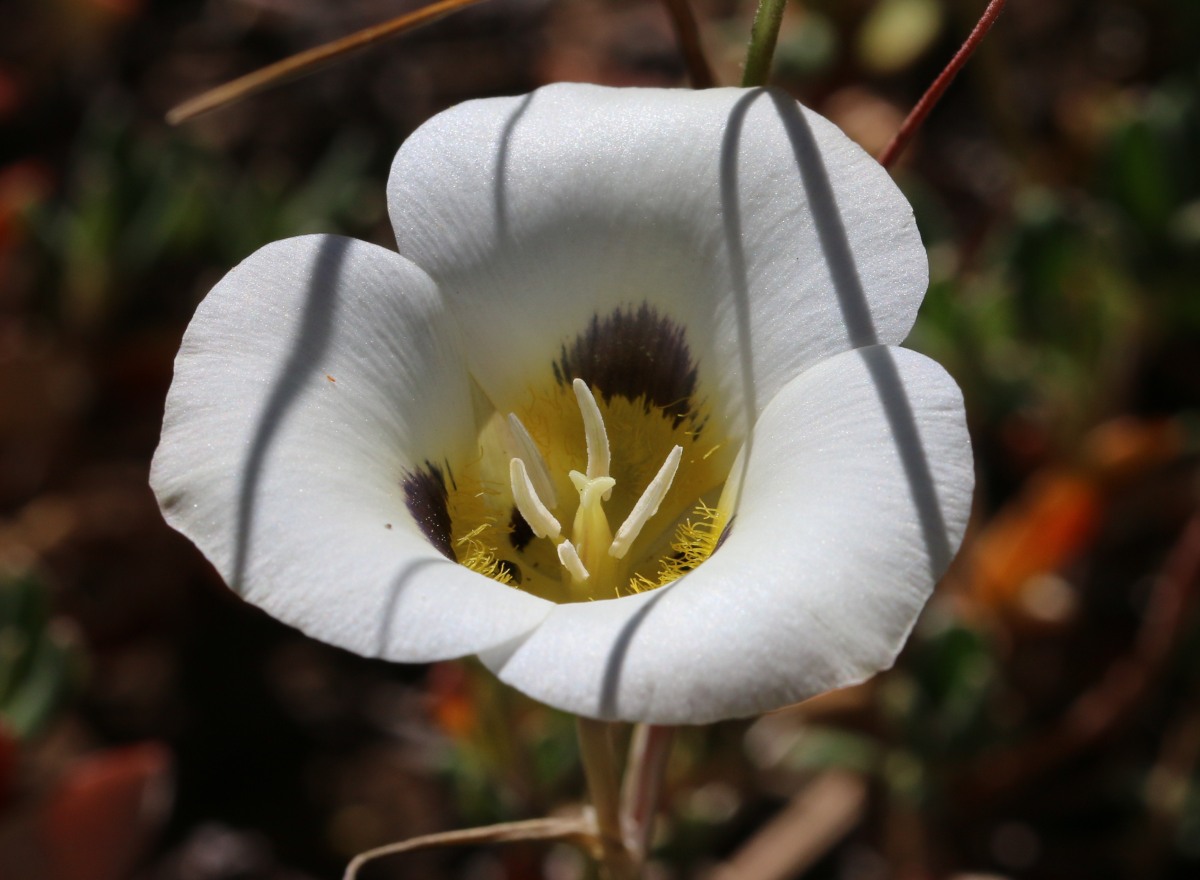
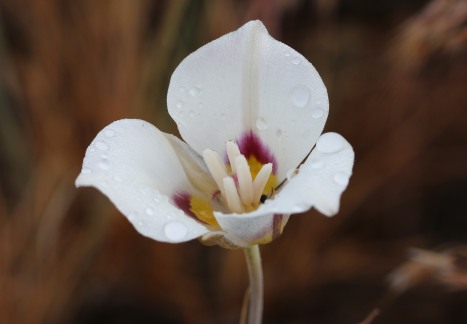
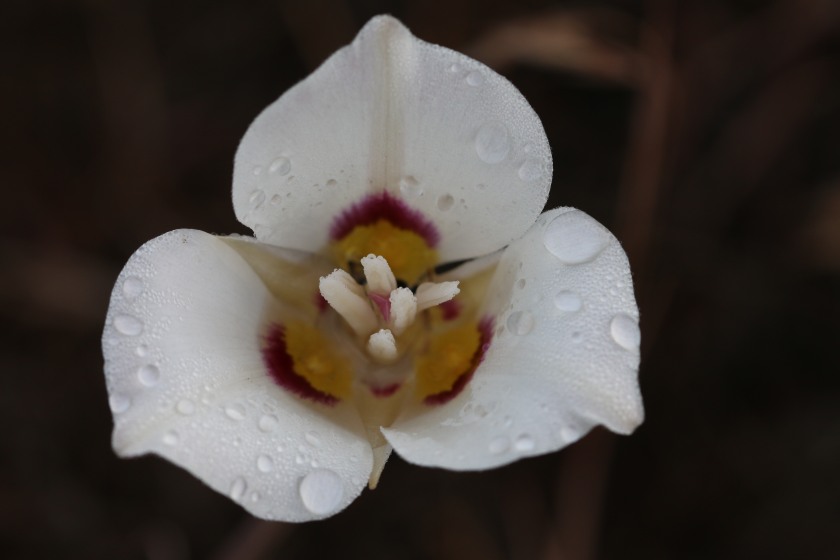
Calochortus leichtlinii

Ethnobotany. A food and a medicine for many Amerindian Peoples: the bulbs were eaten raw or roasted.

Description by the California Native Plant Society. Calochortus leichtlinii is a species of flowering plant in the lily family known by the common names Leichtlin’s mariposa, smokey mariposa, and mariposa lily. The plant is native to the Sierra Nevada and Modoc Plateau of California and adjacent parts of the Great Basin in southeastern Oregon and western Nevada. It grows in coniferous forest and chaparral habitats, including the lowest grassy hills-such as along the Sierra Nevada boundary with the Central Valley and agriculture. Calochortus leichtlinii is a perennial herb producing an erect, unbranching stem up to 60 centimeters tall. The basal leaf is 10 to 15 centimeters long and withers by flowering. The inflorescence is a loose cluster of 1 to 5 erect, bell-shaped flowers. Each flower has three petals 1 to 4 centimeters long which are white, pinkish, or dull blue in color and spotted with yellow and dark red or black and hairy at the bases. These color patterns vary widely among different regional and local populations. The fruit is a narrow capsule up to 6 centimeters long.

Reference Books. The gem of a book for all Calochortus aficionados is : “Calochortus Mariposa Lilies and their Relatives”. By Mary E. Gerritsen and Ron Parsons. 2007. Timber Press. 

Calochortus leichtlinii 02

Calochortus leichtlinii 04

Calochortus leichtlinii 06

Calochortus leichtlinii 07